Apparently, there are more and more scans of folded, out-of-print role-playing games magazines that are becoming available on-line. Let's hope this trend lasts. I understand that copyright holders may get itchy about these online scans but, frankly, what interest do they have in keeping these old issues off line and thus forcing people interested in the history of our hobby to spend ridiculous sums on eBay??
This latest link is for scans of Avalon Hill's short-lived Heroes Magazine, which was devoted to AH role-playing games in the same way that the General was devoted to AH war-games. Now AH main rpg's were RuneQuest III, Powers & Perils and Lords of Creation. I will obviously concentrate on the former, which is unfortunately my least favourite version of the game (if we ignore the broken MRQI).
Shannon Appelcline made a comprehensive index of Heroes Magazine. I'm making available hereunder the parts relevant to RuneQuest/Glorantha:
(note: VI below means Volume I, VII means Volume II; thus VII.4 means 'Volume II No.4')
Accessories, Record Sheets:
Calendrics Record Sheet VII.2 pg 42
Expanded RQ Character Sheet, by John T. Sapienza Jr VII.2 pg 3-6
Ship Data Sheet, by Tim Bailey VII.4 pg 45
Adventures, Alternate Earth:
Gruug's Cave, by Alan LaVergne VII.1 pg 19-35
Black Sorceror, by Mike Olson VII.3 pg 11-26
Adventures, Glorantha:
The Big Hit, by Sandy Petersen VI.6 pg 12-18,31-36
Journey to Falderbash, by Bill Williamson VII.1 pg 12-19
The Wolfrunners, by Sandy Petersen VI.4 pg 21-27
Advice, Players:
Tips for Shamans, by Forrest Johnson VII.4 pg 11-19
Background, Glorantha, Fonrit:
The Land of Fonrit, by Greg Stafford & Sandy Petersen VI.6 pg 36-39
Background, Glorantha, Lunar Empire:
History: Zero Wane, by Greg Stafford (1) VI.1 pg 5-6+
History: First & Second Wanes, by Greg Stafford (1) VI.2 pg 9-11+
History: Third & Fourth Wanes, by Greg Stafford (1) VI.5 pg 33-35
History: Fifth Wane, by Greg Stafford VI.6 pg 4-6
Pottery: First Wane, by Greg Stafford (1) VI.4 pg 46
Background, Glorantha, Pavis:
The Ostrich Clan, by Mike Dawson VII.1 pg 4-11
Creatures:
Abstract Elementals, by James A. Holden VII.4 pg 31-33
Insects for RQ, by Sandy Petersen VI.3 pg 11-13
Cults, Glorantha:
Hykim & Mikyh, by Chaosium VI.4 pg 30-32
Orlanth, by Chaosium (2) VI.4 pg 17-21+
Telmor, by Chaosium (3) VI.4 pg 28-30
Equipment, Ships:
The Sail and the Sword, by Tim Bailey VII.4 pg 23-25+
A Ship for RuneQuest, by Greg Stafford (4) VI.3 pg 40
War Fleets of Glorantha, by Greg Stafford (4) VI.2 pg 42-43+
Magic, Shamanism:
Tips for Shamans, by Forrest Johnson VII.4 pg 11-19
Magic, Sorcery:
A New Look at Sorcery, by B.L. Humphreys VII.1 pg 9-10
New Spells for RQ3, by Martin Crim VII.4 pg 26
NPCs:
Tips for Shamans, by Forrest Johnson VII.4 pg 11-19
Rules, Misc:
New Skills, by Greg Stafford & Sandy Petersen VI.6 pg 11+
Talents for RQ, by Andrew Scott MacKenzie VII.2 pg 39
Rules, Combat, Misc:
Fatigue and Damage Changes, by Jonathan Tweet VII.1 pg 7
RQ Hit Points, by John T. Sapienza, Jr. VII.1 pg 44
Shield Law, by Morgan Woodward VII.2 pg 45
Rules, Combat, Sea:
The Sail and the Sword, by Tim Bailey VII.4 pg 23-25+
Rules, Gambling:
A RuneQuest Gambling System, by Donna Selzer VI.5 pg 15
Rules, Official Questions & Answers:
Dragon Pass VI.6 pg 10-11+
RuneQuestions, by the Chaosium Staff VI.5 pg 40-41
RuneQuestions, by the Chaosium Staff VI.6 pg 39-40
RuneQuestions, by the Chaosium Staff VII.4 pg 21-22
Previews, Misc:
Box 4: Vikings VI.4 pg 5-7
Box 5: Gods of Glorantha VI.6 pg 19-30
Previews, RuneQuest III:
New Face for an Old Friend, by Greg Stafford VI.1 pg 40-41
Testimony of a Tester, by Bruce Dresselhaus VI.5 pg 8
What Happened to RQ, by the Chaosium Staff (5) VI.5 pg 31-32
Reviews:
Dragon Pass VI.6 pg 9-10
(1) The Background of the Lunar Empire, through the Fourth Wane, was also published in Wyrm's Footnotes. Wane 0 appeared in issue 10, Wane 1 in issue 11, Wane 2 in issue 12, Wane 3 in issue 13 and Wane 4 in issue 14.
(2) A variant of this Cult has been printed in RIVER OF CRADLES (AH8591).
(3) A variant of this Cult has been printed in DORASTOR (AH8592).
(4) Reprinted in Tales of the Reaching Moon No.10.
(5) Also appeared in Different Worlds No.37.
About Me
14 March 2013
Deluxe T&T — The Backers
The names of the backers of the Deluxe Tunnels & Trolls Kickstarter project have been posted here. I know it's utterly childish, but I find it soooo cool to see my name on that list :)
06 March 2013
Yog-Blosoth Again
Another terrific picture from Yog-Blosoth:
In Greek mythology, an Oread was a Mountain Nymph — the Greeks had a special name for each type of Nymph, depending on where they were supposed to dwell:
‣ Tree Nymph = Dryad
‣ Freshwater Nymph = Naiad
‣ Saltwater Nymph = Nereid
‣ Mountain Nymph = Oread
For gaming purposes, I'll consider that the Oread is merely a mountain Dryad. And she's ready to lure unwary travellers to a certain death :)
![]() |
| Oread |
‣ Tree Nymph = Dryad
‣ Freshwater Nymph = Naiad
‣ Saltwater Nymph = Nereid
‣ Mountain Nymph = Oread
For gaming purposes, I'll consider that the Oread is merely a mountain Dryad. And she's ready to lure unwary travellers to a certain death :)
25 February 2013
The Magazine Rack
The Internet Archive has opened a new sub-section called The Magazine Rack, which harbours many scans of old magazines, including role-playing and war-gaming magazines (The Dragon, The General, etc.).
Although said 'Magazine Rack' is a real treasure trove for old-school gamers, there isn't much of real interest, alas, for us Gloranthan fanatics.
At the moment, I have found the following of interest:
In The Space Gamer issue 71, p7-9: Converting TFT Characters to T&T. Comments: this is a pretty boring conversion article; it might give you, however, some ideas to be re-used for character generation if you're using my Timinits & Trolls rules.
In The Space Gamer issue 85, p39: The Giant Squid, for RuneQuest. Comments: this can be a fun addition to any marine-based adventure; a kraken is always a welcome surprise!
In The Space Gamer issue 85, p48-50: Gloranthan Metals, for RuneQuest. Comments: this has already been published in various sources, but it is always handy to have this kind of information in one place. Can also be used in conjunction with my previous Rune Identities post.
In The Space Gamer issue 85, p51: The Spy Character Class, for Stormbringer. Comments: this can be easily adapted for a Fonritan game of intrigue and backstabbing.
In The Space Gamer issue 87, p30: Folk Magic, for RuneQuest. Comments: this is a generic article about Folk Magic by Sandy Petersen. The Guidelines therein can be easily adapted to any 'freeform' or 'narrative' style of play. Most useful.
06 February 2013
Deluxe Tunnels & Trolls
The kickstarter for deluxe Tunnels & Trolls got backed way beyond expectations (reminds me of the Guide to Glorantha...). Non-D&D grognards may not be prominently visible on the OSR blogosphere, but they are still there, and they deliver!
Below the preliminary art by iconic T&T artist Liz Danforth:
| click to enlarge |
05 February 2013
Old School Hexcrawl
Exile Island by Konsumterra can be used almost 'as is' for a nice bit of old school hexcrawling off the Umathelan coast!
Let us have a look at all the nice details about Exile Island (aslo called Forbidden Island). Apparently, it used to be part of an empire; it is about 150km × 250km; it is a tropical island; it is covered with rainforest... So basically everything about this island: the history of the place, its size, its climate, its vegetation, makes is a perfect addition to any Second Age Umathelan campaign game!
Let's look at the reasons why the PCs should end up hexcrawling on it:
☠ The PCs could be stranded on the island because their ship sunk: survival game!
☠ The PCs could be on a mission for the ruler of one of the coastal cities: exploration game!
☠ The PCs could be looking for God Learner ruins in order to loot them: plunder game!
02 February 2013
Timinits & Trolls (Rules) ‒ Part Three
The latest issue (No.15) of Rule One Magazine is out, complete with the third and final instalment of my Gloranthan adaptation of the Tunnels and Trolls rules.
To summarise:
So pick up the free PDF précis of the Tunnels and Trolls rules, download all three parts of my house rules, peruse this blog, and you're ready for countless hours of swords & sorcery enjoyment of old-school adventuring in Glorantha's imperial past!
To summarise:
- Part One was an introduction to the chosen setting (Umathela in the Second Age)
- Part Two had all the necessary rules to generate a character
- Part Three has equipment lists, magic, and foes
So pick up the free PDF précis of the Tunnels and Trolls rules, download all three parts of my house rules, peruse this blog, and you're ready for countless hours of swords & sorcery enjoyment of old-school adventuring in Glorantha's imperial past!
01 February 2013
The Painbow
The painbow is one of the mechamagic items crafted by the Zistorite sect of the God Learners. It looks like a crossbow, except that it does not have a bow string, and its stock is much thicker. The stock contains the magic missiles that are fired by the painbow upon pulling the trigger.
This mechamagical weapon is mostly made of metal, as is the Zistorites' wont. Some models, however, especially in Umathela, make use of hard Pamaltelan wood. The bow is usually plain, but some models, like the one pictured above, may have very ornate bows, which can even be used as hand-to-hand weapons, should the mechamagical mechanism jam, or should the charger be emptied.
Until the demise of the Middle Sea Empire, only the Zistorites and their closest allies used painbows. After the independence of the Umathelan cities and the general loss of power and importance of the God Learner sects, some mechamagical weapons, amongst which the painbow, started to be found outside Gord Learner-related circles, mostly in the possession of wealthy collectors, of Malkioni mercenaries, or of plunderers of God Learner ruins.
The weapon itself is manufactured with a certain amount of charges. Different 'series' of weapons get different starting amounts of charges, so it is difficult to give a general amount. It's usually in the two-figure range. The charges are magical in nature, basically magic missiles that inflict pain rather than physical damage upon hitting the target — hence the name of the weapon. The GM is free to work out the exact effects for his or her system of choice.
31 January 2013
The Suckerbunny Tree
Collected from various sources...
The Suckerbunny Tree — A Weird Pamaltelan Monster
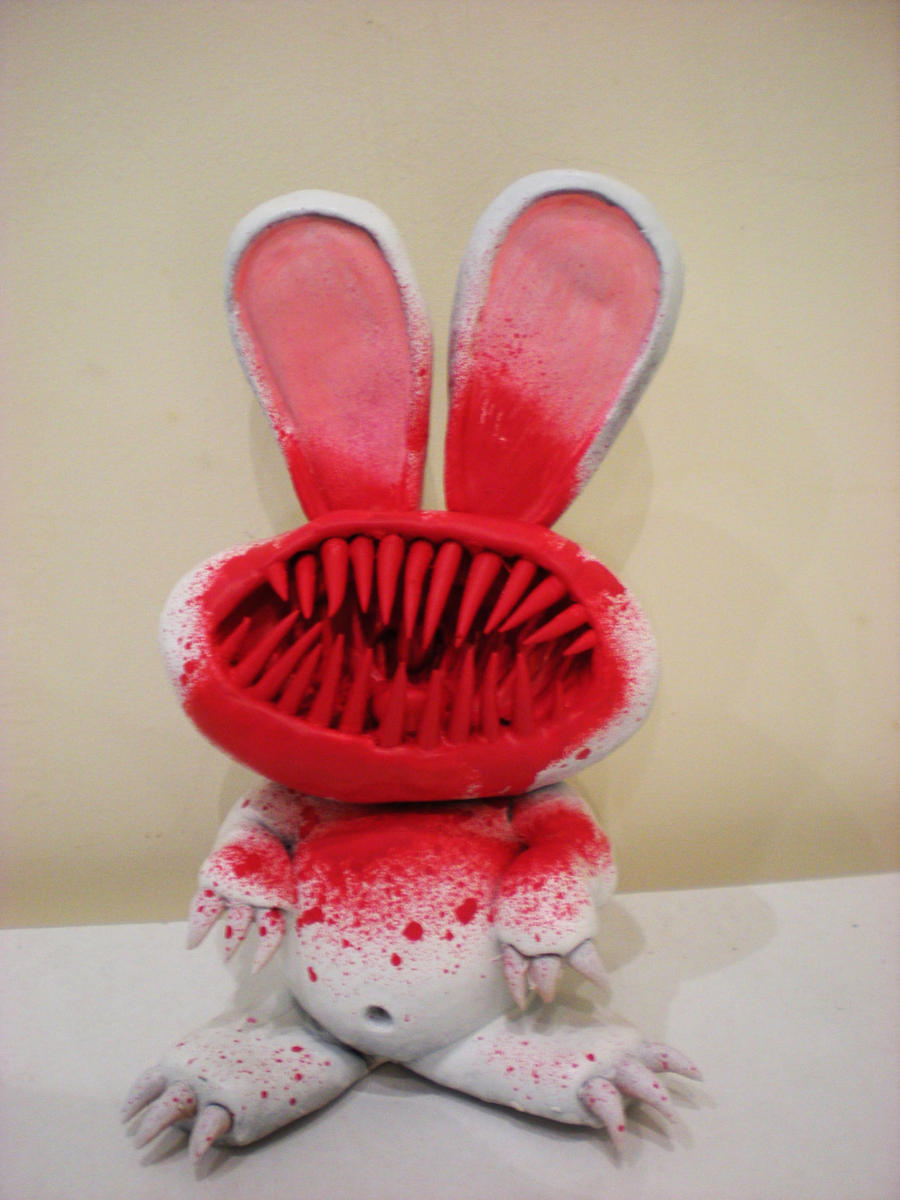
This giant tree curses all the jungle around it. Its unholy fruit, which drops every season, are monsters: the parasitoid suckerbunnies, which feed on all forms of animal life.
Note: This is not really something for my campaign since this monster is found in eastern Pamaltela. But it was too weird not to be mentioned!
30 January 2013
Rune Identities
22 January 2013
Runeblades
I'm 45 soon. I don't know if it's my age, or all the talk about OSR nostalgia and stuff, but I've been re-reading old issues of the White Dwarf magazine (the original one, not the minis catalogue).
Those old issues would often feature RuneQuest articles. In issue 39, p16-17, there is an article titled Runeblades by Dave Morris [Q: is he the same Dave Morris who wrote the Fabled Lands series?] that presents a list of magic blades for rune-level characters for a selection of runic cults.
Here's a short, summarised selection from the article, without too many rules-mechanics details, since the idea is to adapt the 'Runeblades' to your favourite rules system.
Volcanic Sword
This sword is the rune blade of cults tied to the Fire/Sky rune. Whenever needed, the blade will rise in temperature to red-heat within seconds. Any damage that penetrates armour is doubled. This would definitely look dandy in the hands of an Olodo chieftain!
Severblade
This sword is the rune blade of cults tied to the Death rune. The sword does normal damage, but it is so sharp that it cuts easily through armour, thus halving its protective value.
Blurblade
This sword is the rune blade of cults tied to the Mobility rune.The sword moves with dazzling speed, allowing its wielder to always gain initiative (or strike first).
Stormblade
This sword is the rune blade of cults tied to the Air rune. The sword allows its user to summon storms once a day. The storm will muster within ne minute and then last for up to fifteen minutes. Within this zone, all movement is halved, flying creatures must make a successful agility roll (or similar test) to continue flying, communication is impossible, and visibility is restricted to but a few metres.
Nightblade
This sword is the rune blade of cults tied to the Death rune. Nightblades give their user the equivalent of the Troll's Darksense, and a bonus to any stealth-related talent.
Spellblade
This sword is the rune blade of cults tied to the Magic rune. This sword increases the amount of spells its user is able to cast, or adds spell-casting ability to a non-magic-using wielder.
Fortress Sword
This sword is the rune blade of cults tied to the Stasis rune. It enhances to chance to parry.
Chillblade
This sword is the rune blade of cults tied to the Cold rune. Whenever it crits, the sword may inoculate a kind of icy poison into the location that has been hit.
Have fun in bestowing these lethal weapons upon your NPCs. Moreover, since their powers are linked to the rune-level-ness of their wielder, your PCs won't be able to re-use them, should they manage to kill the original wielder!
Those old issues would often feature RuneQuest articles. In issue 39, p16-17, there is an article titled Runeblades by Dave Morris [Q: is he the same Dave Morris who wrote the Fabled Lands series?] that presents a list of magic blades for rune-level characters for a selection of runic cults.
| Those were the times... |
Here's a short, summarised selection from the article, without too many rules-mechanics details, since the idea is to adapt the 'Runeblades' to your favourite rules system.
Volcanic Sword
This sword is the rune blade of cults tied to the Fire/Sky rune. Whenever needed, the blade will rise in temperature to red-heat within seconds. Any damage that penetrates armour is doubled. This would definitely look dandy in the hands of an Olodo chieftain!
Severblade
This sword is the rune blade of cults tied to the Death rune. The sword does normal damage, but it is so sharp that it cuts easily through armour, thus halving its protective value.
Blurblade
This sword is the rune blade of cults tied to the Mobility rune.The sword moves with dazzling speed, allowing its wielder to always gain initiative (or strike first).
Stormblade
This sword is the rune blade of cults tied to the Air rune. The sword allows its user to summon storms once a day. The storm will muster within ne minute and then last for up to fifteen minutes. Within this zone, all movement is halved, flying creatures must make a successful agility roll (or similar test) to continue flying, communication is impossible, and visibility is restricted to but a few metres.
Nightblade
This sword is the rune blade of cults tied to the Death rune. Nightblades give their user the equivalent of the Troll's Darksense, and a bonus to any stealth-related talent.
Spellblade
This sword is the rune blade of cults tied to the Magic rune. This sword increases the amount of spells its user is able to cast, or adds spell-casting ability to a non-magic-using wielder.
Fortress Sword
This sword is the rune blade of cults tied to the Stasis rune. It enhances to chance to parry.
Chillblade
This sword is the rune blade of cults tied to the Cold rune. Whenever it crits, the sword may inoculate a kind of icy poison into the location that has been hit.
Have fun in bestowing these lethal weapons upon your NPCs. Moreover, since their powers are linked to the rune-level-ness of their wielder, your PCs won't be able to re-use them, should they manage to kill the original wielder!
19 January 2013
Issues of S&P Useful for Pamaltelan Games
For the whole time that they held the licence to RuneQuest and Second Age Glorantha, Mongoose did quite a good job in terms of the number of RuneQuest- and/or Glorantha-themed articles available in their free on-line gaming magazine, Signs and Portents (aka S&P).
Not only were these articles free, they were also quite enjoyable and useful, especially the ones written by people with a good grasp of all things RuneQuest-ey like Shannon Appelcline, Loz Whitaker, and Pete Nash.
Here is a list of all the articles with Pamaltelan-compatible or adaptable content:
S&P issue 40
Gloranthan Goodies by Bryan Steele (p41-47)
This article presents a host of bizarre Gloranthan items. Some of them are daft, some other interesting, some others yet really well thought out. I am particularly fond of the Imperial Token of the Learned (p42), of the Tome of Secrets (p42), and especially of the Pollen Arrow (p45).
S&P issue 41
Druids by Tim Bancroft (p6-11)
This is a Gateway (non-Gloranthan) article. However, several ideas can be scavenged if you want to play a 'Plant Brother' type of character using the MRQII, Legend or RuneQuest 6 rules.
S&P issue 43
Twenty Gloranthans by Bryan Steele (p5-14)
As implied by its title, this article is an NPC gallery, with a good array of NPCs from various areas of Second Age Glorantha, and with MRQI stats.
NPCs of interest for Pamaltela-centred games are: the God Learner chronicler (No.1), the Malkioni sorcerer (No.2), the Waertagi runaway (No.3), the Tarint Beast Hunter (No.10), and the Arachan investigator (No.18).
S&P issue 51
The Voralans by Shannon Appelcline (p34-40)
Shannon Appelcline is the expert with regards to all things Aldryami, so this article is a must-read if you're interested in the diminutive fungoid pests, and especially if you want to play a Voralan: Voralan skills, Voralan backgrounds, Voralan professions, weapons, cults... A fantastic article, irrespective of your favourite rule-set or 'Age' to play in Glorantha.
S&P issue 53
Shapeshifters and Deceivers by Carl Walmsley (p22-27)
This is another gallimaufry by Carl Walmsley, who seems to have specialised in this kind of writing. For your Pamaltelan forest, I recommend the Charlatan Plant (p22). For your Pamaltelan swamp, the Cruel Vapour (p23). The Mimic Ghoul (p26) can be a terrific addition to Nontraya's undead.
S&P issue 53
The Voralan Tribes by Shannon Appelcline (p46-50)
This is the continuation of the Voralans article from S&P issue No.51. In this instalment, Shannon Appelcline details the various tribes of Voralans. The ones who live in Pamaltela are the Third Tribe.
S&P issue 63
Plunder of the Elfs by Shannon Appelcline (p29-37)
Shannon Appelcline returns to the delightful 80-ish format of Plunder (a Chaosium supplement for the original RuneQuest) to describe a whole host of Aldryami-destined magic items.
S&P issue 67
RuneQuest Elf Monsters by Shannon Appelcline (p68-77)
This further instalment in the series of Aldryami-centred articles is simply a must. Most creatures can be used in Pamaltela. I particularly like the branchsteed (p69), the snake vine (p75), and obviously the spore cloud (p76) since I'm such a big fan of Slorifings.
S&P issue 76
Gods of the Goblins by Shannon Appelcline (p20-23)
Yippee! As written above, I'm a big fan of Slorifings (aka Goblins) so this article is one of my favourite ones by Shannon Appelcline. The Goblin gods are as devious as their followers, and the spells in the article are really useful to render the nasty Slorifings even nastier.
S&P issue 87
Tomes of Power by Carl Walmsley (p44-46)
Gateway Stakhanovite Carl Walmsley gives us a list of strange magical tomes. Could well be used to stock a wizard's tower if you're running out of ideas (or traps).
S&P issue 89
Shamanism for Fun and Prophets by Bruce Mason, Gary Goldman and Pete Nash (p14-23)
This very long article is necessary if you want to introduce shamanism to your MRQII game, as the rules in the original MRQII book were not sufficiently developed.
S&P issue 90
The World of Spirits by Bruce Mason, Gary Goldman and Pete Nash (p18-34)
Again, a very long article, and a follow-up to the previous one. All this should really have appeared in the MRQII book in the first place. Indispensable if you plan to run your game using the MRQII rules.
S&P issue 91
Wondrous Woods by Carl Walmsley (p44-46)
In this issue, Stakhanovite Carl Walmsley gives us a list of plant-monsters. Not all of them are inspiring or particularly fitting in the context of Second Age Glorantha, but they can be used as impediments to the PCs' travels through any Umathelan forest.
S&P issue 92
Devil's Gulch by Bruce Mason and Dyson Logos (p66-73)
This is a short but deadly adventure set in an unpsecified wilderness location. [SPOILERS] The adventure features lots of Chaotic opponents. Since Chaos isn't strong in the Second Age, I wouldn't particularly recommend this adventure for a campaign set in Second Age Glorantha. However, if you fancy the idea that the abandoned temple has been used as a laboratory by some crazy (and now dead) God Learner, who has somehow attracted all these Chaotic creatures, you may give it a try.
18 January 2013
Improved Place Generator
This is a follow-up to when I blogged about my Impromptu NPC and Place Generator. If you read the comments to that post, Imaginos complained about some combinations being impossible because only one die was used and hence some runes woud l only be rolled with some given row/column combinations. My answer was that I liked simple-n-easy tools, and rolling one die only was my idea of simplicity.
Well, for (a) curmudgeons like Imaginos and (b) people who are OK with rolling two dice when they roll on a random table, here's my IMPROVED PLACE GENERATOR.
So everything works exactly like in the Impromptu Place Giannirator, except that you roll two dice.
Die No.1 — the Place
(remember: die No.1 is the blue die)
Sixth row yields a VILLAGE.
Value rolled: 7: most houses have more than one level
Eighth column yields Average.
The rune under the other die is the Darkness Rune.
Die No.2 — the owner/founder
(remember: die No.2 is the orange die)
1. The die stops in the fifth row, first column.
2. Value rolled: 6.
3. Archetype: CITIZEN. The value rolled (6) yields us the following result: Journeyman / Crafter of a Superior level.
4. On top of the 1st column: 13.
5. Size Small
6. The rune under the other die is the Movement Rune.
Bonus: the map under the transparent sheet. The orange die stopped over the sea, north of the Umathelan coast.
Here's a possible interpretation of the results:
The party arrives in an average-sized village, in which most houses have more than one level. All in all, it is quite populous. The houses are tall and close to each other, so the place feels quite dark, especially in its narrow alleys.
If the PCs have a letter of credence, or are travelling on behalf of an important patron, or are otherwise well-known or puissant, they are introduced to the alderman/burgomaster/provost of the village. He's a jolly, shortish man who leads the local Guild of Artisans. He is himself a skilled wheelwright. Although not particularly dexterous, the man is able to craft high-quality cart wheels. Buying a set of wheels from him will increase the distance travelled by day on any given Umathelan road by 10%. If the PCs manage to get to know him better, they will learn that the man is actually not from Umathela. He was born in Seshnela and travelled throughout the mighty Middle Sea Empire, before settling in Umathela for the love of a local woman.
Well, for (a) curmudgeons like Imaginos and (b) people who are OK with rolling two dice when they roll on a random table, here's my IMPROVED PLACE GENERATOR.
So everything works exactly like in the Impromptu Place Giannirator, except that you roll two dice.
- Die No.1 (the blue die on the photograph) is used to determine the details of the place, as per the original Place Giannirator.
- Die No.2 (the orange die on the photograph) is used to determine the owner/founder of the place, again per the original Giannirator.
- And here's the final twist: in order not to have the runes linked with the rows and columns any longer, you will now use the rune under die No.2 with roll No.1, and the other way round.
| click to enlarge |
(remember: die No.1 is the blue die)
Sixth row yields a VILLAGE.
Value rolled: 7: most houses have more than one level
Eighth column yields Average.
The rune under the other die is the Darkness Rune.
Die No.2 — the owner/founder
(remember: die No.2 is the orange die)
1. The die stops in the fifth row, first column.
2. Value rolled: 6.
3. Archetype: CITIZEN. The value rolled (6) yields us the following result: Journeyman / Crafter of a Superior level.
4. On top of the 1st column: 13.
5. Size Small
6. The rune under the other die is the Movement Rune.
Bonus: the map under the transparent sheet. The orange die stopped over the sea, north of the Umathelan coast.
Here's a possible interpretation of the results:
The party arrives in an average-sized village, in which most houses have more than one level. All in all, it is quite populous. The houses are tall and close to each other, so the place feels quite dark, especially in its narrow alleys.
If the PCs have a letter of credence, or are travelling on behalf of an important patron, or are otherwise well-known or puissant, they are introduced to the alderman/burgomaster/provost of the village. He's a jolly, shortish man who leads the local Guild of Artisans. He is himself a skilled wheelwright. Although not particularly dexterous, the man is able to craft high-quality cart wheels. Buying a set of wheels from him will increase the distance travelled by day on any given Umathelan road by 10%. If the PCs manage to get to know him better, they will learn that the man is actually not from Umathela. He was born in Seshnela and travelled throughout the mighty Middle Sea Empire, before settling in Umathela for the love of a local woman.
17 January 2013
A Nordic-Themed Setting for MRQII
The fine Italian-language blog la Cripta del conte has made available a free Nordic-themed campaign setting, simply titled il Nord (the North), for the Italian version of RuneQuest, which corresponds to the translation of MRQII. As such, it is also highly compatible with RuneQuest 6, and should be easily adaptable to Mythic Iceland.
The setting, as already noted, is an imaginary Nordic-themed continent, which is protected from menacing giants by a huge Tree of Life that grows in its centre. Yet it is not your vanilla good guys-vs-bad guys setting: the interesting twist is that the "good guys" (the inhabitants of the continent who are, presumably, the people of the PCs) are themselves descended from ship-borne invaders who massacred the original, shamanistic inhabitants of the place.
The PDF file is only 15 pages long, yet it manages to offer pretty much everything that is needed for playing in a Nordic milieu within the MRQII framework: languages, currencies, calendar, character backgrounds (cultures & professions), lists of equipment, cults.
The setting could even be ported to Glorantha to be used in Valind, in Ygg's Isles, or in a similar cold milieu.
15 January 2013
My Sandbox
So if you're saying "Old School" you're saying "Sandbox". If you're saying "Sandbox" you're saying "Hex-map". Here's mine. Second Age Umathela, right smack in the centre of Enkloso, with the river Riogache slowly flowing through it in a southeast-to-northwest direction.
Most of the area is ruled, or rather claimed, by Duke Roderick of Varanswal. The central area around the Mere (a large, cool lake) is ruled by his archrival, Count William of Arstranwal. The actual extent of both rulers' authority is along the major paved roads (black on the map), and along the minor dirt roads (light brown on the map). The rest is controlled by uncivilised Umathings— or worse!
I have already ran four adventures; three in the Harlan/Rampart area, one in Greenmound.
Note: 1 hex is 10km.
![]() |
| click to enlarge |
Most of the area is ruled, or rather claimed, by Duke Roderick of Varanswal. The central area around the Mere (a large, cool lake) is ruled by his archrival, Count William of Arstranwal. The actual extent of both rulers' authority is along the major paved roads (black on the map), and along the minor dirt roads (light brown on the map). The rest is controlled by uncivilised Umathings— or worse!
I have already ran four adventures; three in the Harlan/Rampart area, one in Greenmound.
Note: 1 hex is 10km.
Labels:
background,
campaign,
hexcrawl,
map
14 January 2013
A Malki City after the Closing
(Travelling to the city itself amidst the encroaching forest:)
A chill wind blew from the highest peaks, inspiring evil, and making a dismal rustle amongst the woods of chestnut that hung on the mountain’s side, through which we were forced to pass. I never heard such fatal murmurs; nor felt myself so gloomily. I walked out of the sound of the carriage, where the glimmering moonlight prevailed, and began interpreting the language of the leaves, not greatly to my own advantage or that of any being in the universe. I was no prophet of good, but full of melancholy bodings, and something that bordered upon despair.
It was midnight before we emerged from the dark forest, and saw faintly before us the huts of the hamlet where we were to sleep. At our approach, two hags stalked forth with lanterns and invited us with a grin, which I shall always remember, to a dish of mustard and crow’s gizzards, a dish I was more than half afraid of tasting, lest it should change me to some bird of darkness, condemned to mope eternally on the black rafters of the cottage.
[...]
(Within the city itself:)
Nothing can be more sequestered or obscure than its situation. It had rather a deserted appearance; several of its houses being destitute of inhabitants, and crumbling into ruins. Two or three of them, however, exhibited ancient towers, richly mantled with ivy, and surrounded with cypress, that retained the air of having once belonged to persons of consideration.
We perceived among the grass an oblong basin, incrusted with pure white marble. Most of the slabs are large and perfect, and still retain their polished smoothness. The pipes to convey the waters are still discernible; in short, the whole ground-plan may be easily traced. Nothing more remains: the pillars and arcades are fallen, and one or two pedestals alone vouch for their former existence. Near the principal bath, we remarked the platforms of several circular apartments, paved with mosaic, in a neat simple taste, far from inelegant. Weeds have not yet sprung up amongst the crevices; and the universal freshness of the ruin shows that it has not been long exposed.
Stolen from Dreams, Waking Thoughts, and Incidents by William Beckford
08 January 2013
Robber Monks
![]() |
| Please give to the poor, er, to us. |
Today, however, I want to post about Robber Monks. These are less well-known than Robber Barons, but no less a nuisance. This post has been inspired by a book I'm reading about Muslim Sicily. In the book, mention is made of the famous Muslim traveller Ibn Ḥawqal, who wrote a travelogue on Muslim Sicily, the Ṣūrat al-’Arḍ, in which he complained that:
There are quite a few ribāṭ [fortified monasteries] on the coastline, full of freeloaders, scoundrels and renegades, both old and young, poor and ignorant. These people would pretend to perform their prostrations, standing in order to steal money given to charity, or to defame honourable women. Most of them were pimps and perverts. They sought refuge there because they were incapable of doing anything else, and because they had no place to go. They were low-life and rabble...
I love these guys! The concept of Robber Monks can be transposed to coastal Umathela. With the demise of central authority, and with the decrease in alms and donations, some of the fortified monasteries have to resort to extorting 'tolls' from travellers. Some others turn to outright banditry— or worse, as per the text above. Robber Monks needn't be poor and ignorant, though. The demise of Malki civilisation in Pamaltela is still an ongoing, recent phenomenon, so these monks still have access to their fortified monastery in good shape; the road they 'work' on is also in good shape, as are their weapons and their grimoires. All in all, these guys are formidable opponents, and most certainly lord it over a large swath of coastline.
Glass Tokens
Historically, some Muslim countries have relied on glass tokens instead of metal coins whenever metal was too rare to use it for coinage. The glass tokens in the picture to the left, for instance, are from ancient Bactria.
I do not have a map of metal ores in Umathela, and then I know Gloranthan metals are not geological in origin like their earth equivalents, but are mined from the bones of dead gods, so I don't have the slightest idea of the availability of metal in Umathela. However, I seem to recall that most battles betwen gods took place in Genertela; those that did take place in Pamaltela took place further south. My opinion is hence that metal is scarce in Umathela.
This is not a problem for the Umathings, whose trade is basd on barter anyway. It is, however, a problem for the Malki cities of the coast, especially now that they are cut off from the Middle Sea Empire and its supply of metal coins.
I have hence decided that the Malki cities of the coast are increasingly relying on glass tokens instead of metal coins. That will also add to the exoticism of Second Age Umathela☺
06 January 2013
The Good Scorpionwoman
![]() |
| Sleep Tight- Mother is Busy. |
The scorpions I'm most familiar with are called "hairy scorpions", and they live in the Sonora desert, including the places I used to visit as a kid. They are big (5 inches), light yellow, and, unless you're a cricket, pretty harmless. So I got to thinking about scorpions without the baggage that people put on them for being evil and aggressive and venomous. When I found that this variety of scorpion gives live birth and carries its babies on its back, the idea just formed.
She's dressed and her hair is cut like an O'odham woman, of the tribes that live in the Arizona desert. She's got a basket full of de-spined cactus fruit (I figure once you get to a person-sized brain and its caloric needs, being an omnivore has its uses), and she, like her human neighbors, carries her baby on her back.
Now, this is really fascinating. Scorpionfolk, especially in RuneQuest/Glorantha, being chaos creatures, have definitely always carried a 'baggage' of being 'evil and aggressive and venomous'.
Let us remember that Chaos is not so strong in Second Age Glorantha as it is in the Third Age.So why not imagine a lost tribe of non-Chaotic scorpionfolk somewhere in the Tarmo Mountains. It would be interesting to see how the PCs react to non-Chaotic 'monsters'.
Subscribe to:
Posts (Atom)