


I don’t know who created the Adversaries Generator for RuneQuest (the page doesn’t mention any name), but this tool is fuсking brilliant. I absolutely love the detail of being able to choose the format under which the stats of the adversary shall be rendered. I choose FOES for old times’ sake!
About Me
Showing posts with label creatures. Show all posts
Showing posts with label creatures. Show all posts
12 May 2026

20 August 2025
Vampires and Glorantha

Why? Well, because as a mythical creature, the vampire only appeared in European literary fiction in the 18th century. It’s a creature from the modern era, not from Antiquity, and not even from the Middle Ages. I actually even found vampires lame in D&D.
But we can fix this, because mythical creatures feeding on the vital fluids of the living have been present in myth and legend since... forever. However, their depiction is in stark contrast with the ‘charismatic villain’ type popularised by Bram Stoker’s novel and by classic horror film. Vampire-like creatures from antiquity are almost invariably monstrous and repulsive, resembling ghouls rather than European aristocrats.
Given Chaosium’s current art direction for Glorantha, much more inclusive of non-European influences, I would like to suggest the following as alternate inspiration for the vampire:
First and foremost, the vetāla, a class of spirits in Hindu mythology that live close to charnel grounds and that can take possession of dead bodies as vehicles for movement. These animated corpses then cause mischief in nearby villages.
Bhairava is the god of vetāla. As with many fearsome South Asian deities, he is not ‘evil’— his frightening appearance may indicate that he is a fierce protector of the faithful or that he teaches how to transform anger or hatred into understanding. This being said, the way he is depicted can be a source of inspiration for the ‘new’ Gloranthan vampire, in line with the current art used in the game.
 |
| Bhairava |
Second, the strix of Ancient Greece. It was a monstrous bird that fed on the blood of children [hence the D&D ‘stirge’].
Third, let’s look at Inner Asia. The ḫortdan is a vampire-revenant that gets out of its grave at night to feed upon the blood of the living. It can become invisible or turn into an animal. The ḫortdan look bloated (especially after having fed), with a ruddy complexion.
Hence my suggested modifications to the description of the vampire (RuneQuest Bestiary, p105-106):
–Instead of “it takes on a pallid white skin and lustrous hair”: “it becomes bloated with a ruddy complexion”.
–Instead of “it may now turn into a bat, wolf, or smoke”: “it may now turn into a monstrous bird or become invisible”.
Also, since Darkness creatures are so strongly opposed to Chaos, I believe the vampire should be associated to the Shadow Rune, and not to the Darkness Rune.
22 January 2024
Animal Shape-Shifters in Glorantha
 |
| cover of DW #9 |
In RuneQuest 2nd edition (their first appearance), for instance, animal shape-shifters are described as follows under the heading Lycanthropes:
“Shape changers are a lonely breed, tainted with Chaos, and disdainful of civilisation. Few know whether they are animals who can take on human shape, or humans capable of assuming the shape of an animal. In either case, they can assume the strength and senses of the animal form at the expense of some intelligence (varying as to species).
...
Lycanthropes are a very rare breed, no matter what sort of animal they become. The genes for lycanthropy are recessive, so that only matings between lycanthropes will breed true. Most children of two lycanthropes are either animal or human without shapechanging ability.
...
Their Chaotic nature gives them their abilities of shape change and invulnerability to impure metals. They do not receive any of the Chaotic Features shown in Chapter X.
...
The lycanthropes include Bearwalkers, Tiger Sons, Tusk Brothers, and Wolfbrothers.”
In HeroQuest Glorantha, animal shape-shifters are described as follows under the heading Skin-walkers — accompanied by the Beast and Spirit Runes:
“Skin-walkers are shape-changers, and disdainful of civilisation. Few know whether they are animals who can take on human shape, or humans capable of assuming the shape of an animal. In either case, they can assume the strength and senses of the animal form at the expense of some intelligence (varying as to species), with its natural weapons.
...
The skin-walkers known in Dragon Pass and the Holy Country include Bearwalkers, Tiger Sons, Tusk Brothers, and Wolf Brothers. Only the Wolf Brothers are described in further detail here. The God Learners classified them as a type of primitive men they called Hsunchen or Hykimi. There are dozens of different types of Hsunchen throughout the rest of Glorantha.”
In a nutshell, RQ2 tells us that animal shape-changers are lycanthropes tainted by Chaos, whereas HQG describes them as a sort of peculiar Hsunchen. Well, that’s completely different: lycanthropes are basically monsters, whereas Hsunchen are primitive humans. Also, the connection to the Chaos Rune has been replaced by a connection to the Beast and Spirit Runes.
Worse yet, the most recent material (the RQG line) is completely devoid of any references to animal shape-shifters other than the Telmori. The Guide to Glorantha merely mentions (on page 484) that one of the towns in the East Isles has a Tiger Son Guard “comprised of Hsa were-tigers”, which simply adds a layer of confusion since ‘Hsa’ is the name of the tiger Hsunchen tribe according to the Guide (p439 and p561).
It is simply impossible to try and figure out which interpretation is correct (‘monsters’ vs ‘primitive humans’) given the current canon.
A further research on each type of animal shape-changer in the Gloranthan corpus doesn’t provide any particular help either:
A search on ‘Bearwalker’ returns a mention of “the Rathori Bearwalkers from the forests of northern Genertela” in HeroQuest Glorantha, and a very similar one in the Glorantha Sourcebook.
In the HQ supplement Sartar: Kingdom of Heroes, ‘Bearwalkers’ is the name given to the initiates of Odayla (p110). In its sister publication Sartar Companion, there is a description of such an NPC (p133), who “attacks and kills Telmori or Chaos on sight and without hesitation”. We are very far from the Chaotic nature of RQ2 Bearwalkers...
In RQG, ‘Bearwalkers’ is the name given to Odayla Rune Lords (RQG core rules p300, and the Lightbringers p124).
A search on ‘Tiger Son’ returns a long, unofficial article in Different Worlds issue No.9, and a mention of a Tiger Son initiate of Zorak Zoran in Big Rubble.
A search on ‘Tusk Brother’ doesn’t return anything.
⁂
So, to summarise:
★ In early Glorantha (end of the 70s, beginning of the 80s), lycanthropes were animal shape-shifters tainted by Chaos. According to the official rules, you had to be born a lycanthrope, whereas Big Rubble and Different Worlds issue No.9 seemed to imply you might become one via a cult.
★ In the early 2010s (at the time of the Guide and of HeroQuest Glorantha), the concept of ‘animal shape-changers’ seems to have become interchangeable with ‘Hsunchen’. The association with the Chaos Rune is gone, except for the Telmori.
★ Today, with the RQG line, there is no all-encompassing concept any longer. You have the Chaotic Telmori; you have the Bearwalkers who are the Rune Lords of Odayla; Tiger Sons and Tusk Brothers have disappeared. As for the Germanic prefix were-, it is used in the Glorantha Bestiary for the Ducks who are “sometimes called durulz or were-ducks” (p31), even though... they are not shape-changers, they are Beast Men! The inconsistency is total.
15 June 2023
Dragonbane
The Basic Role-Playing System (aka ‘the Chaosium system’) started out as a very slim introductory booklet with just the barebones D100 rules. It wasn’t sold separately but was a free addition to many of the early Chaosium role-playing games that were sold in boxes.
The first game that was marketed as an expansion of the BRP System per se was the boxed set titled Worlds of Wonder, which contained three mini-games that used the same core rules applied to three different genres: fantasy, super-heroes, and sci-fi.
The fantasy mini-game was called Magic World [not the same as the later standalone frp game]; it was translated to Swedish and published as a standalone game in 1982 under the name Drakar och Demoner (Swedish for ‘Dragons and Demons’). As with many BRP-derived games, it went through a tortuous life of its own, changing publishers and/or names several times, and even having a system overhaul once before getting back to the BRP System (albeit with a D20 instead of a D100, à la Pendragon).
The game was purchased by Fria Ligan (Free League Publishing) in 2021, and is now coming back in English as ‘Dragonbane’. Fria Ligan already owns several successful role-playing games, and apparently Dragonbane has adopted a few features from these games.
Anyway, I’ve downloaded Dragonbane’s Quickstart, and I will try and highlight the differences I have found with the Basic Role-Playing System.
Attributes
SIZ has disappeared. As a result, HPs are equal to CON instead of ½(CON+SIZ) or CON with SIZ-dependent adjustments.
Power points/magic points are called willpower points (WPs) and are used for special actions on top of spellcasting.
Game System
A ‘1’ is a crit, and a ‘20’ is a fumble, instead of having more refined D100-based values.
There is a system of boons & banes à la D&D 5E where you roll an additional D20 for each boon/bane and count only the lowest/highest result.
There is also a ‘push’ system like in CoC 7th ed., but it can quickly result in your character getting a bane.
Combat
Each combatant has a single action for each combat round.
Initiative is 1-10 and drawn from a set of numbered cards. Meh.
Parrying is a fully-fledged action and uses up your single action. Meh.
You can do nothing during a round and recover 1D6 WPs. Given the prevalent use of WPs this is pretty cool.
When you roll a crit in combat you get to choose amongst three different effects (double damage, extra action, ignore armour) rather than automatically apply a given effect. This is super cool.
Weapons get damaged more easily than in the BRPS because whenever the armour protection completely negates the damage from a melee attack the attacking weapon itself suffers the damage instead. Ouch.
There aren’t any hit locations. If an opponent is partially covered by an obstacle, you get a bane on your attack.
Monsters
This is where Dragonbane shines: each monster has its unique abilities and attack table. The GM rolls on this table when it is the monster’s initiative (also randomly from the cards). A monster never rolls the dice to hit its target: monster attacks succeed automatically.
I really, really like this. Obviously I haven’t tested this in actual play, but I’d love to see some monster fear instilled back into my players’ eyes. Today they’re only afraid of criticals.
As an example, the giant spider from the sample adventure in the Quickstart has the following attack table:

It’s obviously massive work at the GM’s side to build such a table for each monster in their campaign. However, I really feel like this is the major innovation in Dragonbane.
⁂
Given the similarities with the BRPS I reckon any GM could pick and choose whatever they like best from this game to add flavour to their BRPS games. I guess you should at least download the Quickstart (available for free on DriveThru or directly here).
04 November 2022
the Gateway Bestiary and the Barguest
In my latest blog post, I wrote about the Barguest and, not having the Meints Index to Glorantha (MIG) at hand, I thought it hadn't been described in RQ terms.
Well... yesterday night I retrieved my copy of the MIG from the cellar and, lo and behold!, it did mention the Barguest. The creature is listed as being described in the Gateway Bestiary. So I went to look for my signed* copy of the Gateway Bestiary, and yes there it was on p25, "a sort of fairy dog" whose description is actually more that of an undead dog. The main differences with 'my' take on the Barguest are as follows:
- it Demoralises rather than it inspires Fear
- it doesn't turn Invisible
So maybe now you can have two versions of the Barguest in your RQ games... A spectral one, and an undead one!
*I had to brag about it, didn't I? BTW the little-known Gateway Bestiary has an interesting story. When Sandy Petersen signed my copy, he told me this was how he was hired by Greg Stafford-- he went to Albany with the manuscript, and Greg said 'cool stuff, want a job?' and hired him.
Also (if I am not mistaken), Sandy's maiden publication is also the very first frp bestiary that, instead of merely listing its entries in an alphabetical order, has them grouped by type of creature.
01 November 2022
the Stafford House Campaign and the Barguest

I am currently reading ‘The Stafford House Campaign’, a collection of personal notes and of Amateur Press Association (APA) articles by Greg Stafford. These essays are a narrative of his early RuneQuest campaigns (“expeditions” as he calls them) interspersed with various commentaries, musings and Q & As with other APA contributors.
The book is invaluable for the insight it provides on the very early years of our hobby in general, and on the birth of Glorantha as a frp setting in particular.
You may read my various thoughts about the book here.
One item that struck my fancy is the mention, on p52, of an expedition to ‘release the barguest’. Now I don’t have my Meints Index to Glorantha available right now, but I don’t recall the “barguest” as being a RuneQuest creature.
A friend kindly pointed out that there is a Barghest (with an ‘h’) on p6 of All the Worlds’ Monsters, vol.2.
As a tribute to Greg Stafford’s early RQ expeditions, I present you the Barghest from All the Worlds’ Monsters, vol.2 converted to RuneQuest using Steve Perrin’s conversion guidelines from All the Worlds’ Monsters, vol.3.
Barghest
Type: Undead Spirit
Description: a large spectral hound that may become invisible, and only while invisible will it shriek.
Characteristics
STR 4D6 avg. 14
SIZ 4D6 avg. 14
POW 3D6 avg. 10-11
DEX 2D6+3 avg. 10
The number of hit points of a Barghest equals its POW, hence its hit points equal its magic points. If reduced to zero hit points or magic points, it is destroyed forever.
Move: 10
Base SR: 5
Armour: 5-point spectral hide
Skills: Dodge 50%, Jump 45%, Listen 30%, Spirit combat 50%, Swim 55%, Track 50%.
Magic: The Barghest may spend 3 magic points to turn Invisible.
Weapons
Bite 40% Dmg 2D8+1D4 SR 9
Claw 40% Dmg 1D8+1D4 SR 9
Special attack
Shriek (SR 1): All those hearing the shriek must roll their POW vs the monster’s POW on the Resistance Table or be paralysed with fear for 2D6 combat rounds.
Special defence
A Barghest can only be damaged by magic, e.g., a sword with Bladesharp 4 would do 4 points of damage; Fireblade 3D6 damage. True Weapon spells do normal damage.
The Barghest is completely immune to emotion-affecting magic such as Befuddle, Demoralise, and Fear.
03 July 2021
The Barbapapa
This stems from a humorous thread on Facebook. You don't wanna know.
BARBAPAPA
Zuccarum Netum
The Barbapapa are large, natural shapeshifters living in the wilderness of
Genertela. In their native form, Barbapapa are blob-shaped, with a distinct
head and arms, but no legs. Male Barbapapa have rounder bottoms, whereas female
Barbapapa have a slenderer form. Each Barbapapa can adopt any form they choose,
but they remain easily identifiable by always retaining their faces and their
distinctive colour.
Barbapapa display likeable faces but are actually flesh-eating predators. Their
favourite preys are unsuspecting children whom they attract by singing catchy
tunes. The prey is put to sleep by the lullaby and then its body is slowly
absorbed by the blob-shaped monster.
Even though they are fearsome opponents, Barbapapa will only fight if cornered.
a Barbapapa in Prax

STR 4D6 (14)
CON 3D6 (10-11)
SIZ 5D6 (17-18)
INT 2D6+6 (13)
POW 3D6 (10-11)
DEX 2D6+3 (10)
CHA 2D6+6 (13)
Hit Points: 13 Move: 8
Magic Points: 11 Base SR: 3
Armour: 1-point hide. Some Barbapapa are protected by 2-point thick fur.
Skills: Disguise 75%, Dodge 25%, Hide 85%, Listen 50%, Shapeshift 100%, Spirit Combat 50%, Swim 75%.
Special defence: Since the Barbapapa’s shape-shifting ability is almost instantaneous, it will create a hole around any piercing weapon about to hit its body, or modify it cushion-like in case a blow by a crushing weapon is about to land. As a result, only area-affecting physical attacks may harm a Barbapapa. Specials and criticals will also hit a Barbapapa; in this case, the attack was too precise for the Barbapapa to modify its shape in time.
Barbapapa Hit Locations
Body 01-16 1/11
Head 17-20 1/5
Weapon % Damage SR
Envelop 100 8 points of digestive fluid 1
Pseudopod 50 1D8+1D4 7
20 March 2021
[Jonstown Compendium] The Howling Tower
The Howling Tower is my first foray into the Jonstown Compendium, the Chaosium-sponsored corner on drivethru rpg where fans can sell their own RuneQuest content. My contribution is minuscule (I have made sure everything was consistent with the latest edition of the rules, and I have written the stats of the pre-generated characters): the original author of the adventure is Devin Cutler, and Dario Corallo has been the driving force behind this endeavour, doing the layout, the artwork, choosing what should get in and what should stay out, etc. so it's definitely his baby. Moreover, Dario has transformed a mere adventure into a fantastic adventure pack by adding virtual tabletop maps and counters, handouts, enlarged maps, etc.

Irrespective of my involvement, I really recommend you purchase this adventure pack: if you buy The Howling Tower, you will get everything needed for several session of Old School fun via virtual tabletop play (quite useful in these pandemic times), plus loads of re-useable setting material for any RuneQuest campaign set around the Upland Marsh and/or the village of Two Sisters, or even in north-western Sartar.
Buy it now!
27 February 2020
the Taun Taun

Here are the taun taun’s stats for RuneQuest: Adventures in Glorantha (inspired by the ones that had circulated in the RuneQuest 6 Star Wars supplement some time ago), shown in the familiar Bestiary format.
TAUN TAUN
Arctosaurus Corniger
These large biped reptiles may trot or run on their two hind legs bearing a human-sized rider. These mounts are particularly adapted to the rugged terrain of the Hachuan Shan mountains, and will outrun a horse or any other animal that is not used to mountainous terrain.
They will fight only if cornered, but will carry their rider in battle.
Characteristics (Average)
STR 2D6+18 (25)
CON 2D6+6 (13)
SIZ 4D6+20 (34)
POW 3D6 (10-11)
DEX 2D6+6 (13)
Hit Points: 19 Move: 12
Magic Points: 11 Base SR: 2
Armour: 2-point thick fur, plus horns on head.
Skills: Dodge 35%, Listen 60%.
Taun Taun Hit Locations
Tail 01-02 2/6
Right hind leg 03-04 2/7
Left hind leg 05-06 2/7
Abdomen 07-09 2/8
Chest 10-14 2/8
Right foreclaw 15 2/5
Left foreclaw 16 2/5
Head 17-20 4/7
Weapon % Damage SR
Butt* 45 2D8+3D6 6
Kick* 45 1D8+3D6 6
*a taun taun will kick if cornered, but it will rather butt and then flee if it has a choice.
05 December 2018
Darktongue 101
 |
| Xoroho Hellspeaker |
The many examples of Darktongue words and nouns found in the canonical sources show that Darktongue follows a familiar pattern of (mostly) CV and CVC syllables. In terms of pronunciation, all we have is American English approximations, for instance here on the glorantha.com web-site. Initial “X”, for instance, looks like it is pronounced [z], and most words are paroxytones, so the name of our friend Xoroho here is probably pronounced zo-RO-ho.
So, anyway, what I have done is I have taken all Uz names and words I have been able to find in the various canonical sources and I have broken them down into syllables. The syllables are listed here. The idea is to freely recombine them so as to create new Darktongue names and words.
A few elements are personal additions, like:
- Making a distinction between initial x- and initial z-, which induces a slight pronunciation difference
- Considering that many finals are actually the same sound, and that Greg Stafford has transcribed them differently because of the difficulty of transcribing Darktongue into American English
- Transforming the expected sound into something else (for fun)
- Considering that Darktongue <s> is slightly different (again, for fun)
Some sounds and/or syllables are hapax legomena, e.g., <f>; you may want not to use them.
Darktongue Sound & Syllable List
a [a]Ca CaC ar Car Cang Can aC az a
b, initial [b]
ba bang bar bas be beer bi bo bom boom bor boz bu
b, final [b]
ab clob glob zub
ch, initial [t͡ʃ]
chak chur
d, initial [d]
da dag dar de dee dem den do dol dood
d, final [d]
dood glod ud
e [e]
e en eC Ce Cem Cen Cer CeC Ceッ
ee [i:]
ee beer meel Cee
f, final [f]
zaf (hapax legomenon)
g, initial [g]
ga gag gan gar ge ger gic gig go gor gork gu
g, final [g]
dag gag gig kag kog rag trag twag xag xig
h, initial [h]
han he hi ho hom hor hy
i [i]
i in gic yil Ci Cig Cik Cing
j, initial [d͡ʒ]
jak jes
k, initial [k]
ka kag kan kang kar karth kat ke kee ker keッ ki ko kog ku kurz ky
k, final [k]
chak drok gic jak lak mook rak ric
gl/kr, initial [ɢ/q]
clob cro gla glob glod kro
ch, final [q]
gork tuch
l, initial [l]
la lak lar le lee len li lo loッ
l, final [l]
dol mal meel ol yil
m, initial [m]
ma mal man mar mee meel mi mo mon mook mor
m, final [m]
bom boom den han hom um xem
n, initial [n]
na nee no
n, final [n]
an den en gan in kan len man mon oon ran ron xen
ng, final [ŋ]
bang kang ting zong
o [o]
cro kro ol xio Co Com Con Cong Cor CoC Coッ
oo [u:]
boom dood mook oon
ow [o:]
tow
p [p]
pa pand pi
qu, initial [kw]
quar
r, initial [r]
ra rag rak ran ras re ree rer ri ric ro ron ror ruz
r, final [r]
ar Car Cer Ceer Cor Cur
s, initial [sˤ]
sli so su
s, final [sˤ]
bas jes ras tas
t, initial [t]
ta tas ting tor tow tuch
t, final [t]
et kat
th/tr, initial [tˤ]
drok tha trag tro twag
rth/rz, final [tˤ]
karth kurz pand
u [u]
chur kurz ruz tuch ud um uz zub Cu
v [v]
va var vo vu
x, initial [zˤ]
xag xem xen xi xig xio xo
y, consonant [j]
ya yil
y, vowel [aɪ]
hy ky
z, initial [z]
zaf zar zo zong zu zub
z, final [z]
az boz ez ruz uz
zh, initial [ʒ]
zha
gemination, final†
keッ loッ
†Notes
Square brackets [ ] indicate the IPA pronunciation
ッ means the following syllable starts with a double consonant; cannot occur at the end of words
C indicates any consonant
V indicates any vowel
The following don't sound particularly Darktongue, I have considered them as hapax legomena:
- Gothant, Iverd, Orshad (three trollkin names from Pavis and Big Rubble)
- Syllables with an initial w- (Degla Wat and Heka Iwog, Dark Trolls, Griffin Mountain)
01 December 2017
Dealing With Demons – Parts Two and Three
17 November 2017
Dealing With Demons – Part One
When you talk about RuneQuest and Old School, you inevitably think White Dwarf – at least if you are 40~50 years old and European.

One series of RQ articles we all remember fondly (even if it was “Gateway”, i.e., not set in Glorantha) was the one about demons and demonology. The first instalment in the series, titled “Dealing With Demons”, appeared in White Dwarf issue No.44 (August 1983). The good news is that it has just been made available on Dave Morris' blog. Enjoy!

One series of RQ articles we all remember fondly (even if it was “Gateway”, i.e., not set in Glorantha) was the one about demons and demonology. The first instalment in the series, titled “Dealing With Demons”, appeared in White Dwarf issue No.44 (August 1983). The good news is that it has just been made available on Dave Morris' blog. Enjoy!
05 February 2015
Giant Pamaltelan Rodent
the following has been inspired by a BBC article shared by Dr Moose on the Gloranthan G+ community
 The largest ever rodent used its huge front teeth like tusks, defending itself and digging with them instead of just biting food. The bull-sized cousin to the guinea pig died out around two million years ago. It has been surmised that its bite was as strong as a tiger's - but its front teeth were built to withstand forces nearly three times larger. This suggests that its 30cm incisors were much more than eating implements.
Only a single fossilised skull has been found belonging to this 1,000kg South American rodent, known as Josephoartigasia monesi. Unearthed in Uruguay in 2007, the animal lived in the Pliocene period - a warm era when large mammals were relatively abundant, including the first mammoths. It remains the largest rodent ever discovered.
Researchers believe the front teeth must have been used for tasks that required extra muscles, like the neck, as well as the biting action of the jaw muscles themselves. "We concluded that Josephoartigasia must have used its incisors for activities other than biting, such as digging in the ground for food, or defending itself from predators," said an anatomist. "This is very similar to how a modern-day elephant uses its tusks."
Josephoartifasia, or the bull-cavy by its Pamaltelan name, would naturally find its place in Pamaltela amongst the other Pliocene- and Pleistocene-like creatures.
Only a single fossilised skull has been found belonging to this 1,000kg South American rodent, known as Josephoartigasia monesi. Unearthed in Uruguay in 2007, the animal lived in the Pliocene period - a warm era when large mammals were relatively abundant, including the first mammoths. It remains the largest rodent ever discovered.
Researchers believe the front teeth must have been used for tasks that required extra muscles, like the neck, as well as the biting action of the jaw muscles themselves. "We concluded that Josephoartigasia must have used its incisors for activities other than biting, such as digging in the ground for food, or defending itself from predators," said an anatomist. "This is very similar to how a modern-day elephant uses its tusks."
 |
| the extinct rodent (right) pictured in comparison with a human and a pacarana, its closest living relative |
22 April 2014
Pamaltelan Flora and Fauna

Original Post, 17 April:
I have been working on menus... er... encounter charts for my Trolls in Pamaltela game. Since there is little for me to go on, I am wondering what terrestrial analogues to use for flora and fauna. Africa and Australia come to mind, but which regions? Are there other areas I should borrow from? How about epoch? Does the existence of megafauna mammals and dinosaurs point me to points in the past?
A Selection of Comments:
Jeff Richard, 17 April
I tried to give some guidance in the Guide. So for example in Fonrit:
The coastal areas and river valleys are densely populated and fertile. Shovel-tuskers (amebelodon) can be found in the coastal lowlands, and sea-going crocodiles inhabit the rivers.
Or in Umathela:
A wide variety of megafauna can be found in the forests and river valleys of Umathela, including giant sloths, giant armadillos (glyptodons), several species of long-tusk elephants (gomphotheres), running bears (arctodus), shovel-tuskers (amebelodon), sky bulls, and scimitar-toothed cats (homotherium). Alynx live in Vralos, but are rare in Enkloso.
As for in Errinorru, there is just lots of weird stuff, as the Hsunchen entry hints:
Many different Hsunchen peoples live in the jungles of Pamaltela. All are Mesolithic or Neolithic cultures, hunter-gatherers with some forest gardening. They are called Fiwan or the Oldest People by the Doraddi and Fonritians and are believed to have assisted the Creator in making the world. Most are friendly with the Aldryami and most are hostile to outsiders.
The Pujaleg Bat People and Te Huantal Jaguar People are among the best known of the Errinoru Hsunchen, but dozens of Hsunchen groups are known, including the:
• Ayotkulakti (Glyptodon People) - known to make shields and armour out of glyptodon shells;
• Dirithi (Giant Sloth People) - a race of 15-foot-tall peaceful giants;
• Gerfaunz (Giant Horned Okapi People) - who ride their strange beasts (sivatherium) in the jungle;
• Koripi (Mole People) - a subterranean race of pygmy albinos;
• Ngwena (Crocodile People) - crocodile worshipping savages;
• Olmakau (Hippopotamus People) - fierce warriors who transform into hippopotamuses; and
• Yaquma (Anaconda People) - seductive snake people who prey on other humans.
Among the most feared are the legendary Crocodile-Bear (andrewsarchus) People of the eastern Dinal Jungle and the Two Horned Beast (arsinoitherium) Riders of South Elamle.
The sentient giant ape people (gigantopithecus) of the Haxamu Jungle are not true Hsunchen, although they are often ranked among them. Nor are the Siwafu Army Ant People, who can transform themselves into hundreds of thousands of flesh-eating ants.
Barry Blatt, 17 April
Howzabout Queensland in Australia and New Guinea? Take it back to the Pleistocene and you have lots of odd beasties to choose from, echidnas, an odd type of sabre-tooth tiger, bunyips, tree kangaroos, drop bears, and you can borrow pygmy rhinos and orang-utans from nearby Java and Sumatra without anyone noticing the mismatch. And bung in Komodo Dragons, New Zealand's skinks and tuataras and some really big anacondas for luck.
Hannu Kokko, 18 April
This one might be useful http://www.ttrotsky.pwp.blueyonder.co.uk/annex/
Jeff Richard, 18 April
For what it is worth, Sandy came up with the list of megafauna used in the game. Sandy's reminder was that Pamaltela has even more prehistoric things (particularly from the Tertiary Period) than Genertela, and that you should feel free to add whatever really cool megafauna mammals you have always wanted to see in a setting. Then try to figure out their ecology in reverse.
10 February 2014
Dryad Treasure Chest
The following post has been inspired by a picture on the fantastic Chaudron Chromatique blog.
It is a well-known fact that Humans are incredibly greedy. Plant-Men are aware of this, and they take advantage of this cognisance to trap unwary human travellers to their forests and jungles.
The Dryad Treasure Chest is one such artifice. Mreli or Embyli (depending on the local flora) would persuade a pair of Dryads to grow together in an embrace around a treasure chest. This is quite a sacrifice for the two Dryads because they are then linked to the treasure chest instead of being linked to a whole grove of trees. Only a single tree from the grove remains with them and grows on top of the treasure chest.
Each treasure chest has been individually crafted and filled in by the Plant-Men, so it is difficult to generalise as to its contents. Plant-Men would usually fill it with precious treasures such as gems or magical items that carry a slight, nearly undetectable dwimmer-craft that gives off its negative effects weeks or even months after having been displaced. The idea is to affect the largest possible number of Humans.
The treasure chest itself is quite difficult to get hold of, so as not to arouse the suspicion of the greedy adventurers. The Dryads' eyes have the usual glamour-like effects, and their arms are very strongly curled round the treasure chest. The fruit hanging from the branches is brightly-coloured so as to entice the unwary into tasting it, to ill effects.
Tunnels & Trolls version
Dryad Treasure Chest
(1) Each Dryad has eyes that cast a glamour-like effect onto anyone gazing directly into them. Technically, any delver looking at either Dryad must make a L5SR on WIZ or any Talent along the lines of "Resist Charm" or "Immune to Plant Magic". If the saving roll is missed, the victim remains in a lovestruck state for 1D4+1 hours; during this time, the victim wants to protect the Dryads and the chest, and will violently oppose anybody harming or otherwise messing around with the Dryads, the chest or the fruit.
(2) The Dryads won't otherwise act, but they have a combined STR of 50 around the treasure chest. This combined STR must be overcome to take the chest away. The chest weighs (1D6+4)×20 pounds.
(3) Should the delvers try to hack down the Dryads rather than overcome the STR of their arms, consider that the combined Dryads have a MR of 450.
(4) The fruit (of which there are always several available on the branches) looks alluringly delicious. Any delver looking upon the branches must make a L4SR on INT or any applicable Talent. If the saving roll is missed, the victim will rush to the tree to eat some fruit.
Roll 2D6 for the effects:
02 | Victim is immediately turned into a Slorifing and runs away. He or she is an NPC now. The player may roll up a new character.
03 | Victim is immediately turned into the appropriate form of Plant-Man (Mreli or Embyli)
04 | Victim will worship Aldrya (if male)/Uleria (if female) from now on. Victim loses any magic associated with his or her former cult.
05 | Victim becomes of the appropriate colour (brown or yellow); no other ill effect, but victim will have a hard time in less tolerant areas ("burn the monster!")
06 | Victim becomes a plant-human hybrid. Roll 1D6 to find out which part of the body becomes vegetable: 1- head, 2- arms, 3- chest, 4- abdomen, 5- groin, 6- legs. The vegetable body part now contains sap instead of blood; it cannot be healed by human healing magic, only by Aldryami healing magic from now on. If the groin is affected, the victim can only produce children with a Dryad from now on.
07 | Victim will forever defend vs plant magic with a penalty of 1 level, e.g., if the GM calls for a L2SR, the victim will have to make a L3SR.
08 | Victim becomes vegetarian.
09 | Victim becomes vegetarian and develops a hatred for non-vegetarians.
10 | Victim becomes a frugivore.
11 | Victim is slowly transformed into the appropriate form of Plant-Man (Mreli or Embyli), over a process that lasts 1D12 months.
12 | Victim is slowly transformed into a Slorifing, over a process that lasts 1D12 months. Once the transformation is complete, the victim runs away. He or she is an NPC now. The player may roll up a new character.
(5) The treasure itself. The GM must decide what the treasure contains. 1 magical item + a stash of coins are suggested. The coins are important because they are possibly going to be spread amongst hundreds if not thousands of humans over time.
1D4 months after the treasure has been retrieved, the ill effects kick in. Anyone in contact with any part of the treasure, even a single coin, must make a L1SR on LK and a L2SR on CON. If the LK saving roll is missed, apply the effects of a random 1st level spell. If the CON saving roll is missed, the victim loses 1 permanent point of CON through spore contamination.
It is a well-known fact that Humans are incredibly greedy. Plant-Men are aware of this, and they take advantage of this cognisance to trap unwary human travellers to their forests and jungles.
The Dryad Treasure Chest is one such artifice. Mreli or Embyli (depending on the local flora) would persuade a pair of Dryads to grow together in an embrace around a treasure chest. This is quite a sacrifice for the two Dryads because they are then linked to the treasure chest instead of being linked to a whole grove of trees. Only a single tree from the grove remains with them and grows on top of the treasure chest.
Each treasure chest has been individually crafted and filled in by the Plant-Men, so it is difficult to generalise as to its contents. Plant-Men would usually fill it with precious treasures such as gems or magical items that carry a slight, nearly undetectable dwimmer-craft that gives off its negative effects weeks or even months after having been displaced. The idea is to affect the largest possible number of Humans.
The treasure chest itself is quite difficult to get hold of, so as not to arouse the suspicion of the greedy adventurers. The Dryads' eyes have the usual glamour-like effects, and their arms are very strongly curled round the treasure chest. The fruit hanging from the branches is brightly-coloured so as to entice the unwary into tasting it, to ill effects.
 |
| art by Cédric |
Tunnels & Trolls version
Dryad Treasure Chest
(1) Each Dryad has eyes that cast a glamour-like effect onto anyone gazing directly into them. Technically, any delver looking at either Dryad must make a L5SR on WIZ or any Talent along the lines of "Resist Charm" or "Immune to Plant Magic". If the saving roll is missed, the victim remains in a lovestruck state for 1D4+1 hours; during this time, the victim wants to protect the Dryads and the chest, and will violently oppose anybody harming or otherwise messing around with the Dryads, the chest or the fruit.
(2) The Dryads won't otherwise act, but they have a combined STR of 50 around the treasure chest. This combined STR must be overcome to take the chest away. The chest weighs (1D6+4)×20 pounds.
(3) Should the delvers try to hack down the Dryads rather than overcome the STR of their arms, consider that the combined Dryads have a MR of 450.
(4) The fruit (of which there are always several available on the branches) looks alluringly delicious. Any delver looking upon the branches must make a L4SR on INT or any applicable Talent. If the saving roll is missed, the victim will rush to the tree to eat some fruit.
Roll 2D6 for the effects:
02 | Victim is immediately turned into a Slorifing and runs away. He or she is an NPC now. The player may roll up a new character.
03 | Victim is immediately turned into the appropriate form of Plant-Man (Mreli or Embyli)
04 | Victim will worship Aldrya (if male)/Uleria (if female) from now on. Victim loses any magic associated with his or her former cult.
05 | Victim becomes of the appropriate colour (brown or yellow); no other ill effect, but victim will have a hard time in less tolerant areas ("burn the monster!")
06 | Victim becomes a plant-human hybrid. Roll 1D6 to find out which part of the body becomes vegetable: 1- head, 2- arms, 3- chest, 4- abdomen, 5- groin, 6- legs. The vegetable body part now contains sap instead of blood; it cannot be healed by human healing magic, only by Aldryami healing magic from now on. If the groin is affected, the victim can only produce children with a Dryad from now on.
07 | Victim will forever defend vs plant magic with a penalty of 1 level, e.g., if the GM calls for a L2SR, the victim will have to make a L3SR.
08 | Victim becomes vegetarian.
09 | Victim becomes vegetarian and develops a hatred for non-vegetarians.
10 | Victim becomes a frugivore.
11 | Victim is slowly transformed into the appropriate form of Plant-Man (Mreli or Embyli), over a process that lasts 1D12 months.
12 | Victim is slowly transformed into a Slorifing, over a process that lasts 1D12 months. Once the transformation is complete, the victim runs away. He or she is an NPC now. The player may roll up a new character.
(5) The treasure itself. The GM must decide what the treasure contains. 1 magical item + a stash of coins are suggested. The coins are important because they are possibly going to be spread amongst hundreds if not thousands of humans over time.
1D4 months after the treasure has been retrieved, the ill effects kick in. Anyone in contact with any part of the treasure, even a single coin, must make a L1SR on LK and a L2SR on CON. If the LK saving roll is missed, apply the effects of a random 1st level spell. If the CON saving roll is missed, the victim loses 1 permanent point of CON through spore contamination.
18 June 2013
Lioness Lamia
When it comes to inspirational art, Le Chaudron chromatique is definitely one of my favourite blogs. Cédric just keeps posting the most inspirational weird illustrations in an amazing black-and-white ligne claire style. I have already posted quite a few of his works (just click on the inspirational label on the left hand-side), which are usually inspired either by Slavic mythology or by weird fantasy à la Lamentations of the Flame Princess — and both of them are definitely cool with me!
Today's picture is an awesome Lamia crawling out of her lioness body. Cédric presents various theories as to why Lamiæ should hide in a lioness body, and various consequences as to their ecology. They can all be adopted for a Second Age game.
 |
| click to enlarge |
Today's picture is an awesome Lamia crawling out of her lioness body. Cédric presents various theories as to why Lamiæ should hide in a lioness body, and various consequences as to their ecology. They can all be adopted for a Second Age game.
31 January 2013
The Suckerbunny Tree
Collected from various sources...
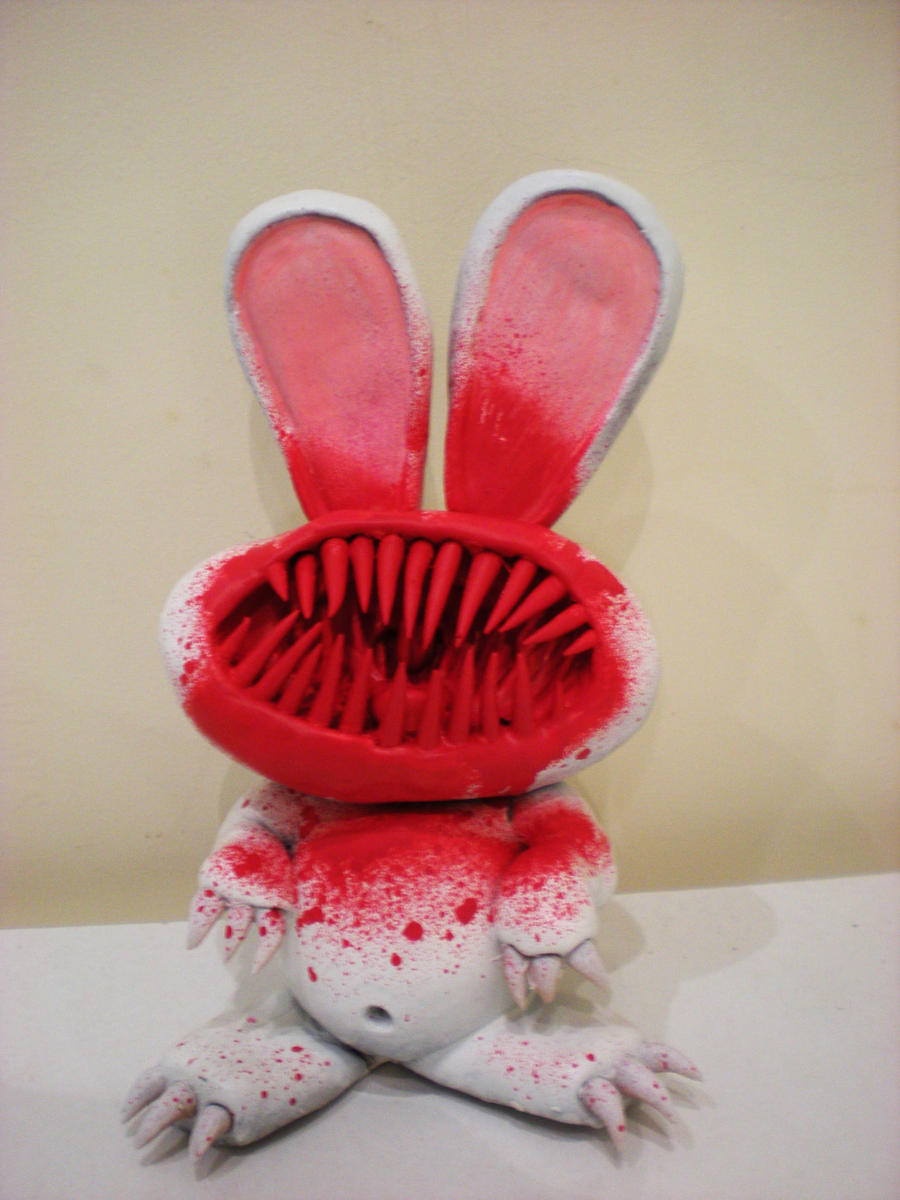
The Suckerbunny Tree — A Weird Pamaltelan Monster
This giant tree curses all the jungle around it. Its unholy fruit, which drops every season, are monsters: the parasitoid suckerbunnies, which feed on all forms of animal life.

Note: This is not really something for my campaign since this monster is found in eastern Pamaltela. But it was too weird not to be mentioned!
The Suckerbunny Tree — A Weird Pamaltelan Monster
This giant tree curses all the jungle around it. Its unholy fruit, which drops every season, are monsters: the parasitoid suckerbunnies, which feed on all forms of animal life.
Note: This is not really something for my campaign since this monster is found in eastern Pamaltela. But it was too weird not to be mentioned!
06 January 2013
The Good Scorpionwoman
 |
| Sleep Tight- Mother is Busy. |
The scorpions I'm most familiar with are called "hairy scorpions", and they live in the Sonora desert, including the places I used to visit as a kid. They are big (5 inches), light yellow, and, unless you're a cricket, pretty harmless. So I got to thinking about scorpions without the baggage that people put on them for being evil and aggressive and venomous. When I found that this variety of scorpion gives live birth and carries its babies on its back, the idea just formed.
She's dressed and her hair is cut like an O'odham woman, of the tribes that live in the Arizona desert. She's got a basket full of de-spined cactus fruit (I figure once you get to a person-sized brain and its caloric needs, being an omnivore has its uses), and she, like her human neighbors, carries her baby on her back.
Now, this is really fascinating. Scorpionfolk, especially in RuneQuest/Glorantha, being chaos creatures, have definitely always carried a 'baggage' of being 'evil and aggressive and venomous'.
Let us remember that Chaos is not so strong in Second Age Glorantha as it is in the Third Age.So why not imagine a lost tribe of non-Chaotic scorpionfolk somewhere in the Tarmo Mountains. It would be interesting to see how the PCs react to non-Chaotic 'monsters'.
09 December 2012
Forest's Guardian
(dedicated to Hervé Carteau)
 The Forest's Guardian is a large, animal-like plant construct magically animated by the Great Tree of a given Aldryami Forest for purposes of self-defence in times of danger, typically to confront invaders. The Forest's Guardian will remain in the vicinity of the Great Tree to make sure it is unharmed.
Sometimes, the Great Tree of an Aldryami Forest becomes mad. In this case, the Forest's Guardian may be created for nefarious, rather than defensive, purposes, and it may hunt down any sentient species it encounters, including elves, irrespective of their actual behaviour towards the Great Tree.
Despite its size, the Forest's Guardian moves at incredible speed through the forest.
HQ Characteristics
Large 5Ш
Fast 5Ш
Devouring maw 3Ш2
Liana attack 5Ш2
Lacks central nervous system 8Ш
Lacks Man Rune 8Ш
T&T Characteristics
MR 350
Combat dice 36D + 175
Special: 9/Ensnare - Lvl 5 SR against DEX or be ensnared within the creature (see picture above); Lvl 5 SR against STR to break free.
BRP/RQ Characteristics
STR 6D6 (21)
CON 6D6 (21)
DEX 4D6 (14)
SIZ 3D6+20 (30-31)
INT 2D6 (7)
POW 4D6 (14)
CHA 5
Move: 12
Hit points: 26
Damage Bonus: +2D6
Armour: 5 points
Attacks:
Special defence: The Guardian lacks the Man Rune and is hence immune to spells such as Harmonise, and to any mind-affecting spells or powers (Befuddle, etc.)
Hit Location Table: Since the Guardian does not have a central nervous sytem, and since it immediately regrows (or rather re-sprouts) any lost limb, it is assumed to have but a single hit location.
Should the Guardian have ensnared one or more victims, then any damage to the Guardian may actually affect the ensnared victim.
For 1 victim, roll 1D20: on a roll of 1-2, the victim is hit; 3-20, the Guardian is hit.
For 2 victims, roll 1D20: on a roll of 1-2, the 1st victim is hit; on a roll of 3-4, the 2nd victim is hit; 5-20, the Guardian is hit.
And so on...
LotFP Characteristics
Armour as leather + shield.
Move as unencumbered man.
HD 8. #AT 3: maw/liana/liana, D 1D10/1D8+ensnarement/1D8+ensnarement.
Ensnarement:
Save vs Paralyse or be ensnared.
To break free: use the Wrestling rules. Consider that the Guardian has STR and DEX 18.

Sometimes, the Great Tree of an Aldryami Forest becomes mad. In this case, the Forest's Guardian may be created for nefarious, rather than defensive, purposes, and it may hunt down any sentient species it encounters, including elves, irrespective of their actual behaviour towards the Great Tree.
Despite its size, the Forest's Guardian moves at incredible speed through the forest.
HQ Characteristics
Large 5Ш
Fast 5Ш
Devouring maw 3Ш2
Liana attack 5Ш2
Lacks central nervous system 8Ш
Lacks Man Rune 8Ш
T&T Characteristics
MR 350
Combat dice 36D + 175
Special: 9/Ensnare - Lvl 5 SR against DEX or be ensnared within the creature (see picture above); Lvl 5 SR against STR to break free.
BRP/RQ Characteristics
STR 6D6 (21)
CON 6D6 (21)
DEX 4D6 (14)
SIZ 3D6+20 (30-31)
INT 2D6 (7)
POW 4D6 (14)
CHA 5
Move: 12
Hit points: 26
Damage Bonus: +2D6
Armour: 5 points
Attacks:
- Maw 55%, 1D10+dmg bonus
- Liana (×2) 75%, 1D8+dmg bonus. Any victim hit must roll his DEX vs the creature's DEX on the Resistance Table. Failure means the victim is ensnared within the Guardian (see picture above). Every following round, the victim may try and break free by roll his STR vs the creature's STR on the Resistance Table.
- Life Sense
- The Forest's Guardian is attuned to the Forest's Song and hence can never be surprised, always know where its foes are, etc.
Special defence: The Guardian lacks the Man Rune and is hence immune to spells such as Harmonise, and to any mind-affecting spells or powers (Befuddle, etc.)
Hit Location Table: Since the Guardian does not have a central nervous sytem, and since it immediately regrows (or rather re-sprouts) any lost limb, it is assumed to have but a single hit location.
Should the Guardian have ensnared one or more victims, then any damage to the Guardian may actually affect the ensnared victim.
For 1 victim, roll 1D20: on a roll of 1-2, the victim is hit; 3-20, the Guardian is hit.
For 2 victims, roll 1D20: on a roll of 1-2, the 1st victim is hit; on a roll of 3-4, the 2nd victim is hit; 5-20, the Guardian is hit.
And so on...
LotFP Characteristics
Armour as leather + shield.
Move as unencumbered man.
HD 8. #AT 3: maw/liana/liana, D 1D10/1D8+ensnarement/1D8+ensnarement.
Ensnarement:
Save vs Paralyse or be ensnared.
To break free: use the Wrestling rules. Consider that the Guardian has STR and DEX 18.
23 October 2012
Hag
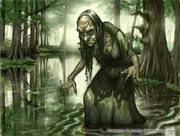
I am going to steal the T&T description of the hag from Trollamancer's Critter Guide (a most recommended site for all T&T enthousiasts).
Here's my version, slightly adapted to Umathela:
Hags ("Suberiads" in Gloranthan lingo) are a general class of unkind female mystics, some living, others more like liches, some are former witches or wizards, others are merely uncharitable wretches who have fallen into the wiles of Gark or Nontraya. They are more or less mortal and can be harmed by ordinary weapons, although many of them will have magical protections of various kinds. Most hags will have the ability to control mystically a kind of weather or element or animal [Anaxial's Roster p222: A Suberiad can command any non-sentient creature that inhabits her lair, whether or not it was born there. In addition to mundane animals, this often includes undead or other monsters. Suberiads can always sense events occurring anywhere within their dwelling.].
Nearly all have some sort of attribute drain attack. Many hags make a sort of Mental Attack; their Mental-MR equals 2D6 (doubles add & roll again) times five. The victim must fight back using Mental Combat ability [magic-using classes get one die per level, everyone else uses 3 dice; adds are calculated like combat adds but based only on INT & LK (over 12); and Charisma functions as CON]. If they defeat a victim (reduce CHR to zero), they will either transfer permanently 2D6 points of their chosen attribute, or enslave the victim as a mindless zombie.
Subscribe to:
Posts (Atom)


