Rick Meints’ Forward to 𝘊𝘶𝘭𝘵 𝘊𝘰𝘮𝘱𝘦𝘯𝘥𝘪𝘶𝘮 (2002): “I find it amazing that virtually all of this material [basically what is contained in the 𝘎𝘭𝘰𝘳𝘢𝘯𝘵𝘩𝘢𝘯 𝘊𝘭𝘢𝘴𝘴𝘪𝘤𝘴] came out within the span of only three years.”

13 November 2012

the Evolution of Gloranthan Runes

I've always loved the sheer beauty and the immediate, evocative power of the Gloranthan runes. I've also found their design, with the clear, thick black line with slightly irregular edges one of the most alluring aspects of Glorantha.

My first contact with Gloranthan runes was obviously with the original 25 runes as presented in the Chaosium RuneQuest 2 rules, viz:
Elemental Runes

Darkness


Water


Earth


Air


Fire/Sky


Moon


Form Runes

Plant


Beast


Man


Dragonewt


Spirit


Chaos


Condition Runes

Mastery


Magic


Infinity


 Power Runes

Harmony


Disorder


Fertility


Death


Stasis


Movement


Truth


Illusion


Luck


Fate


Cults of Prax introduced the following further rune:

the "Issaries" rune; also called Communication, Equal Exchange, or Trade in later publications


RuneQuest 3, even though supposedly separated now from Glorantha, did mention the Gloranthan runes in the rules. In my perfectbound Avalon Hill Deluxe Edition, they are on p243 without any break-down into Power, Condition, etc. categories, but simply listed alphabetically as: Air, Beast, Chaos, Darkness, Death, Disorder, Dragonewt, Earth, Fertility, Fire [rather than Fire/Sky as in RQ2], Harmony, Illusion, Infinity, Law [a new rune], Magic, Man, Mastery, Moon, Movement, Plant, Spirit, Stasis, Truth, Water.
There are 24 runes in all: Fate and Luck are gone; Law has been added:

Law


Cults of Terror (a RQ2 supplement) introduced the "Undead" rune for the cult of Vivamort, and described it as being a combination of life and death. It actually looks like a horizontal Fertility rune with a vertical stroke in its centre:

Undead


This very same rune, however, was introduced as the "Hunger" rune for the cult of Krarsht in Gods of Glorantha and Lords of Terror (both RQ3 supplements).


Other runes from that time were collected in the Cult Compendium from the Gloranthan Classics imprint of Moon Design:

Light; also called Sun elsewhere in that book


Heat


Ice


Cold


Dragon


The Cult Compendium also lists the aforementioned Undead rune as a Form rune. The Light, Heat, Ice and Cold runes are classified as "modified Element runes". No classification is mentioned for the Dragon rune, although we may assume it is a Form rune.

After the long spell without any Gloranthan publications, the Gloranthan runes came back with Hero Wars and HeroQuest. Unfortunately, these rule sets brought about an inflation in the number of runes, which now numbered in their hundreds. I hated that.

I am not going to list all of the new runes; it would take up too much space. The original RQ2 categories were still there, modified as follows.
5 Elemental runes: Darkness, Water, Earth, Fire/Sky, and Air/Storm — Moon is gone, despite the game's heavy emphasis on the 'Lunar v Orlanthi' conflict.
5 Form runes: Mineral, Plant, Animal [Beast], Man, and Otherworld Being [Spirit] — Dragonewt and Chaos are gone, replaced with Mineral, which actually may be a good idea:

Mineral


The category of Condition runes is gone. There is now a crapload of "Additional Magical Ability Runes" amongst which one may find the Magic and Mastery runes.
The category of Condition runes has also disappeared. It is replaced with the category of "The Ten Ancient Polarities" with pretty much the same runes.

What I dislike most with the new runes is that they do not respect the early simplicity and symmetry of the original RQ2 runes. I do not intend to use them, except some of the more regular ones, like e.g.:

Defence


HeroQuest 2 goes somewhat back to the original RuneQuest 2 runes and rune classification in its 'Gaming in Glorantha' chapter. It lists:
5 Elemental runes: Darkness, Water, Earth, Air, and Fire.
8 Power runes, in opposing pairs: Harmony v Disorder, Fertility v Death, Stasis v Movement, Truth v Illusion.
5 Form runes: Plant, Beast, Man, Spirit, and Chaos. Despite the interesting innovations of HQ, we're back (except for the Dragonewt rune, which has gone) to the early Gloranthan canon.
3 Condition runes: Mastery, Magic, Communication. Almost the same array as in RQ2, except that the seldom-used Infinity rune has been replaced with the beloved Communication rune.
HeroQuest 2 then lists several "Other Runes": Moon, Cold, Heat, and Light, as less-accepted or specialised Element runes; some of the early Gloranthan runes: Luck, Fate, and Law; and then many of the daft HQ runes, mostly as deity-related runes, e.g.

Malkion


RuneQuest 6, the most recent incarnation in the long line of RQ rule books, also goes back to the early canon, with:
6 Elemental runes: Air, Darkness, Earth, Fire, Moon, and Water.
5 Form runes: Beast, Dragon, Man, Spirit, and Plant.
10 Power runes, in opposing pairs: Harmony v Disorder, Movement v Stasis, Fertility v Death, Truth v Illusion, Law v Chaos.
5 Condition runes: Infinity, Law, Magic, Mastery, and Communication — except that Law is not described in this section but in the previous one... bad proofreading?

For once I consider that the much-maligned Mongoose RQ (of which RQ6 is a streamlined and improved version) features a slightly better take on the canonical runes, which I really really like (plus, they are adapted to Second Age Glorantha):
7 Elemental runes: Air, Darkness, Earth, Fire, Metal [WTF???], Moon, and Water.
7 Form runes: Beast, Chaos, Dragon, Dragonewt, Man, Spirit, and Plant.
14 Power runes, in opposing pairs: Cold v Heat, Death v Fertility, Disorder v Harmony, Fate v Luck, Motion v Stasis, Illusion v Truth, Light v Shadow.
5 Condition runes: Infinity, Law, Magic, Mastery, and Trade.

 Shadow


I will present in a later post the array of runes I intend to use for my Second Age Umathelan campaign.

11 November 2012

RuneQuest 6 - Pete & Loz Interview

Pete & Loz, the authors of RuneQuest 6, are interviewed over at RPG.net by Shannon Appelcline. You may read the whole interview here. Much interesting insight with regards to how RQ6 came to be, and a little information about future products (like Monster Island below).


05 November 2012

Timinits & Trolls (Rules) ‒ Part Two

The latest issue of Rule One Magazine is out, complete with Part Two of my Gloranthan adaptation of the Tunnels and Trolls rules.
After Part One, which was a mere introduction, Part Two features Character Generation, complete with:
  • two new characteristics, Perception (PER) and Knowledge (KNW);
  • starting money;
  • a wealth of Umathelan- and Malki-specific character classes such as the Templar, the Alchemist, the Minstrel, or the Sage;
and much more.


28 October 2012

Rampart

Rampart was a heavily fortified city that was built at the height of the Middle Sea Empire's extension on the banks of the river Quarni in southern Enkloso.

In that area, the river Quarni (which flows from the Tarmo mountains towards the sea) separates an ancient rainforest from the plains.

Bizarrely enough, the Middle Sea Empire built the fortified city on the forest side of the river rather than on the plains side. A huge fortified bridge above the river Quarni joined the city with the rest of Umathela. The fact that the city laid on the forest side of the river was a puissant testament to the Middle Sea Empire's hubris.

After the demise of the Middle Sea Empire, the Malki inhabitants of the city slowly deserted it. Plants quickly gained ground in the now-abandoned city, which is now in ruins.

24 October 2012

Map of Pamaltela

From the forthcoming Guide to Glorantha: the official map of Third Age Pamaltela. OK, it is a Third Age map and features all those horrible Elf forests, but still...


23 October 2012

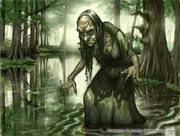
Hag

Hags appear prominently in Slavic folklore; I thus plan to make them a regular feature of my Umathelan campaign.

I am going to steal the T&T description of the hag from Trollamancer's Critter Guide (a most recommended site for all T&T enthousiasts).

Here's my version, slightly adapted to Umathela:

Hags ("Suberiads" in Gloranthan lingo) are a general class of unkind female mystics, some living, others more like liches, some are former witches or wizards, others are merely uncharitable wretches who have fallen into the wiles of Gark or Nontraya. They are more or less mortal and can be harmed by ordinary weapons, although many of them will have magical protections of various kinds. Most hags will have the ability to control mystically a kind of weather or element or animal [Anaxial's Roster p222: A Suberiad can command any non-sentient creature that inhabits her lair, whether or not it was born there. In addition to mundane animals, this often includes undead or other monsters. Suberiads can always sense events occurring anywhere within their dwelling.].

Nearly all have some sort of attribute drain attack. Many hags make a sort of Mental Attack; their Mental-MR equals 2D6 (doubles add & roll again) times five. The victim must fight back using Mental Combat ability [magic-using classes get one die per level, everyone else uses 3 dice; adds are calculated like combat adds but based only on INT & LK (over 12); and Charisma functions as CON]. If they defeat a victim (reduce CHR to zero), they will either transfer permanently 2D6 points of their chosen attribute, or enslave the victim as a mindless zombie.

18 October 2012

Quick Starting Equipment

Another useful post from gaptooth: Quick Starting Equipment. I'll obviously have to adapt his post for Timinits & Trolls and Umathelan characters— who will necessarily have different starting equipment from faux-mediæval European ones.

The guidelines from the post, however, can be safely followed. With my obsession of less rules, less stuff written on the character sheet, I fully endorse the idea that a given character class corresponds to a given set of starting equipment (BTW this is what I have done in my book The Celestial Empire).

Now in a game that has less strict professions/character classes such as Timinits & Trolls, it's not as straightforward. Saying that any 'thief' PC has thieving tools is a no-brainer. But what about the 'jack-of-all-trades'— he obviously cannot have the tools of all trades!

16 October 2012

The Closing


A Malki port before the Closing

The very same port after the closing

15 October 2012

RuneQuest 6 Review

The ever spot-on Lev Lafayette has published an in-depth review of RuneQuest 6. This review is recommended reading, especially to old grognards who wonder what differences lay between the latest incarnation of their favourite fantasy role-playing game and previous editions.

There are also several threads currently going on over at the RQ-Rules mailing list precisely on spell balance, differences with previous editions, etc. Do subscribe if you are interested.

T&T Character Sheet

I've found a nice T&T Character Sheet (compatible with both T&T 7+ ed. and Timinits & Trolls) here: T&T Character Sheet.

13 October 2012

Plant-Men and Sentient Animal-Human Hybrids

The following is on top of the post I wrote 6 months ago about Plant-Men; Greg has added an interesting piece about the various races of 'Elves' on the Moon Design web-site, which I am copying here for ease of reference:

Q: What colour of Elves have existed in Glorantha? What plants are they associated with? Do they still exist?

A: The first point to make is that the 'colour' classification of Elves is a God Learner construct, and, though widespread among many humans, is not used by Elves themselves. It is not a literal description of the appearance of the Elf races, who appear generally plant-like in many typical hues — green or yellow leaves, colourful flower-like parts, etc. The colour associations are from God Learner sorcerous investigations that related these types to elemental associations. Thus, Brown and Green are both Earth Colours, Blue is the Water Colour, and so on. Red Elves are the Heat of the south, while the Yellow Elves were found by the God Learners to be much closer to Halamalao, God of Light, than any other type of Elf.
Secondly, two common uses of the term 'Elf' are found in Gloranthan usage. One strictly refers only to a humanoid plant-being that is associated with trees. The second more broad usage is common among humans to refer to a wide range of different plant beings, not all of which are true woody elves. The term Aldryami would be more correct for the latter. Even some types of "Elves" are not actually true Aldryami, a word reserved for those beings descended from Aldrya, Gata, Aron, and Halamalao.
With those provisos in mind, the best known types of Elf are as follows:
Brown Elves (Mreli): These are associated with deciduous trees, and are the most common type of Elf in Genertela at the end of the Third Age. When Elves work they always group together no matter what tree they are from, and so it is common to see Elves from willow, birch, oak and elm living together. Since Elves are related to local species of trees not all Brown Elves are known to each other. The Genertelan and Pamaltelan forests are the most obvious example of this estrangement.
Green Elves (Vronkali): Associated with coniferous trees, they are the sole elven inhabitants of the pine forest of Winterwood in northern Fronela. Green Elves are also found in all Brown Elf forests, which they protect while the Mreli hibernate through the winter. Tree Elves do not recognise a segregation of types among themselves and so Green Elves are mixed with the Brown. Observers usually note that Elf groups have individuals who correspond to many types of trees among them.
Yellow Elves (Embyli): Associated with tropical evergreen trees, the Yellow Elves are the most common type in Pamaltela, and are also found in southeastern Genertela, the East Isles and other islands. Yellow Elves, like others, come in many shapes and sizes, colours and leafage, all depending upon the species they are related to. Where Green and Brown Elves are found in the same areas as Yellow Elves (notably in Fethlon, Vralos and the Pamaltelan mountains), the different species mix together in a single Aldryami society.
White Elves (Halamali): White Elves were the first children of Flamal, nurtured by the pure light of Halamalao, the Aldryami sun god. The White Elves were related to the magical trees that grew in the highest forests covering the slope of the Spike in the Godtime. When the Spike exploded, the immortal forests were destroyed, so that no White Elves remain in Glorantha today. White Elves are still in the God Plane. They are the celestial trees, from whence they are worshipped by the Elves today.
Moon Elves (Rufeldryami): These Elves live only in special imperial gardens, though a multitude live among the forests on the Red Moon, especially the Tendarshan Forest on the Moon's northeast face. Others are found in the hero planes of the God World. The Moon Elves have never left their protected gardens, so that many non-Lunars doubt their very existence. They are so beautiful that most mortals are knocked senseless by their mere scent. [Note: there aren't any Moon Elves in Second Age Glorantha]
Fire Elves (Olembi): In the far south of Pamaltela, beyond the lands of mortal men, everything is made of fire so that hills, rivers and the vales in between are all burning. The Fire Elves are associated with the fiery trees that cover huge parts of the landscape. The have never visited the Inner World during time except aboard the firebergs. In visions of the Hero Wars many seers have seen the burning of vast forests. A few others, claiming more clarity, say that the burning forests seen in so many visions are not doom for the Elves, but part of the Aldryami plan, and shows the Fire Elves coming to aid their kin.
Blue Elves (Murthoi): Water-breathing Aldryami related to forests of kelp and other large water-plants, Blue Elves are still found in coastal waters, as well as in some large freshwater rivers and lakes. There are several species of human sized Murthoi (though humans are generally unaware of the differences between them), and many smaller types unrecognised outside of the waters.
Black Elves (Voralans): These are associated with fungi, and live in isolated forests of giant mushrooms that are often found cultivated in and near Troll lands. They have never been numerous on the surface world because they require such dank conditions for health. Occasionally these beings are found in other Elf communities, like the puffball or mushroom people found in Genertelan forests. Voralans are not true Aldryami, because they are descended from Mee Vorala rather than Aldrya.
Red Elves (Slorifings): Also known as 'goblins', these beings are associated with ferns and mosses and are still common in the great swamps of Pamaltela. Two huge nations of Slorifings exist, one on the east and the other on the west of Pamaltela. These include a huge number of species of Slorifing with a range of appearance from the humanoid to the monstrous. The Slorifings are usually found in mixed groups, but generally reject the woody Aldryami, since the Slorifings are not true Aldryami themselves.

Another interesting Q&A is the following one about hybridisation between sentient races:

Q: Is it possible for a human and an elf to have a child? How about other races?

A: The Gloranthan intelligent races are all separate species and are not able to breed with humans or each other. Elves, in particular, are intelligent and mobile plants and cannot normally reproduce with the 'meat-people'. Sexual activities are possible with some species of Aldryami, though this resembles sex only to the human partner, not the Elf or Dryad. Even Trolls cannot breed with humans, though sexual practices are very similar among the two races, and sexual relations are possible, though extremely rare.
However, in the earliest myths these beings had not yet differentiated, and so some bizarre cross breeds were spawned then. Those powerful fertility magics could be obtained by HeroQuesting and used to circumvent the normal restriction. In particular the Empire of the Wyrm's Friends were able to produce cross-breeds of different intelligent species (and even with animals, though not with plants), but no one has done this since. As the Hero Wars unfold, player Heroes of an eccentric bent might find ways to get these magics again, but this would be an incredibly difficult task, and the usefulness of such an act is questionable in any event.

The interesting reference in the passage quoted above is the one to the practices of the Empire of the Wyrm's Friends, which is a Second Age empire — and a rival to the Middle Sea Empire.
I can imagine that human-animal hybrids do exist in the Second Age, spawned by the EWF's horrendous magics. Some of these sentient hybrids may have been captured by, or fled to, the Middle Sea Empire. With the Closing upon the coasts of Pamaltela at the time of the campaign described in this very blog, some of these magical hybrids may thus have been stranded on Pamaltela and, with the demise of the Middle Sea Empire, may have been freed. The picture below then becomes a very inspirational piece of art:


A tiger-human sentient hybrid and a former Umathing slave are battling their way out of a ruined subterranean stronghold of the God Learners. On their way to the surface world, they stumble upon a squad of horrific rat-human hybrids, who have decreed this portion of the underworld should be theirs!
All are using Zistorite weapons found abandoned in the subterranean ruins.

10 October 2012

Art for Umathela (8)

I've found this picture on the internet:


The forest has encroached on an abandoned Malki city that used to belong to the Middle Sea Empire. A group of Aldryami are wandering through the plant-covered ruins, and are having fun with the stuff they have salvaged from the God Learner buildings. The Wort-Man on the foreground is trying out a God Learner staff (not sure it's a good idea...), whilst the one on the background is looking at the pictures in a Malki book.

19 September 2012

T&T: New French-Language Edition - Spell Glossary (Part Two)

This is a companion post to the 7 September post.

Should an English-speaking person try and use a French-language T&T supplement, here's the French-to-English spell glossary:

Abeilles porte-malheur    2    Unlucky Bees
Abracadabra    1    Hocus Focus
Allez, hop !    4    Upsidaisy
Allez, Va-t'en (AV)    1    Oh Go Away (OGA)
Antidote    4    Too-Bad Toxin (TBT)
Autométamorphose    8    Imafrawg
Bénédiction du dieu troll    5    Trollgod's Blessing
Bien fermer    1    Lock Tight
Bling-bling    1    Sparkle
Bon esprit    5    Dear Lord
Bouge pas ! (BP)    1    Hold That Pose (HTP)
Bouge-moi    10    Blow me to…
Bouge-toi    11    Blow you to…
Ça c'est de la barbe !    1    That's a Natty Beard (TNB)
Casse    5    Breaker Breaker
Confusion    3    Befuddle
Conjuration    3    Dis-Spell
Contrôle des esprits    2    Spirit Mastery
Coup du sort    8    Patterns of Fate (PoF)
Coup dur    2    Whammy
Coupe le cordon    11    Cut the Cord
Crème de la Kremm (CdK)    1    Crème de la Kremm (CdK)
Debout les morts ! (DLM)    1    Dem Bones Gonna Rise (DBGR)
Déflecteur de magie    5    Resist Magic
Démon invisible    12    Invisible Fiend
Double vue    5    Second Sight
Double-double    4    Double-Double
Drelin    2    Ding-a-Ling
Ékremmage    1    Suppress Kremm
Envol    3    Fly Me
Et on reprend couleur    6    Blue Shirt of Life (BSL)
Exométamorphose    9    Yerafrawg
Exorcisme    12    Banishing
Expertise    3    For What It's Worth (FWIW)
Explosion de puissance infernale (EPP)    10    Hellbomb Burst (HB)
Fais dodo    3    Rock-a-Bye
Feu à volonté    3    Fire at Will
Feu follet    1    Will-o-Wisp
Flaire magie    1    Detect Magic
Fluide glacial    2    Dura-Spell Battery
Guérison    3    Healing Feeling
Guimauve Infâme    3    Slush-Yuck
Indic    3    Find Person
Invocation    12    Summoning
Invocation de l'eau    1    Call Water
Invocation du feu    1    Call Flame
Lame de Vorpal    1    Vorpal Blade
Lame infaillible    2    Unerring Blade
Langue universelle    10    Wizard Speech
Maximus    11    Bigger is Better
Méduse    9    Medusa
Mini-portion (PP)    10    Smaller is Smarter
Mirage    2    Mirage
Mur invisible    7    Invisible Wall
Nécromancie    12    Nefarious Necromancy
Nuage de malheur (NDM)    3    Devoted Rain Cloud (DRC)
Œil de chat    2    Cateyes
Œil omnipotent    2    Omnipotent Eye
Pains de glace    3    Freeze Please
Passe-passe    5    Zingum
Patauge    2    Glue You
Pentagramme protecteur    4    Protective Pentagram
PES    5    ESP
Pieds ailés    2    Little Feets
Planque    2    Hidey Hole
Prends-Ça (PC)    1    Take That You Fiend! (TTYF)
Prise rapide    3    Hard Stuff
Prof    1    Teacher
Protège-moi    3    Shield Me
Puissance explosive    3    Blasting Power
Pygmalion    9    Pygmalion
Qui est là ?    1    Know Your Foe
Qui va là ?    1    Who's There?
Raclée    7    Zappathingum (ZapT)
Radiesthésie    2    Find Object
Remaniement    12    Omniflex
Renaissance    13    Born Again
Revers de fortune (RdF)    6    Reversal of Fortune (RoF)
Sang-Dragon    8    Zapparmor (ZapA)
Smog    4    Smog
Sort Mortel n°9 (SM9)    9    Death Spell #9 (DS9)
Souffle bobo    2    Poor Baby
Source mortelle    9    Mortal Source
Tiens, le voilà (TV)    1    Oh There It Is (OTh)
Toc toc    1    Knock Knock
Toqué    4    Dum-Dum
Vérole mentale    5    Mind Pox
Vision animée    6    Porta-Vision
Visions mystiques    6    Mystic Visions
Voyage astral    11    Ghostly Going
Zizanie    3    Firestorm of Protest (FOP)
Zombi    8    Zombie Zonk

18 September 2012

Yay! Second Age Gloranthan Travelogue in the Works!

Pete Nash of BRP Rome and RuneQuest 6 fame is working on a "field guide"-like bestiary for Second Age Glorantha written in the manner of the real world bestiaries of yore. Rather than paraphrasing his post from the Moon Design forum, I'll simply re-post it over here:

For those of you who have an interest in Gloranthan monsters, the good news is that the Bestiary has been finished for quite a while now. In fact I completed it more than a month ago, but due to the release of Pavis and my own hectic workload for RuneQuest 6, I haven’t gotten round to posting anything about it.

So to help out Jeff, I thought I’d write a bit about the book and the design concept behind it.

When Jeff first approached me with the concept of writing a Bestiary I was somewhat wary. My enthusiasm was jaded by the work I’d previously put into Monster Island, which due to certain circumstances I ultimately did not submit to Mongoose. Jeff’s irrepressible enthusiasm however, soon got me to change my mind. What he envisioned was not yet-another splat book full of characteristics and combat skills, but something in homage to the Sandy Petersen’s Field Guide publications.

For those of you who have never seen one of these Petersen’s Field Guides, they are stat-less but very evocative descriptions of the weird creatures of the Dreamlands and Cthulhu Mythos, supplemented with stunningly beautiful, full page art. After Jeff posted me his own personal copy to wet my appetite, I was hooked and began to think about how the text of the book should be presented.

Since Jeff knows that I’m an armchair classicist, he suggested I write the book as if it the author was a Second Age God Learner, in the style of Herodotus, Pliny and Aelian. That is to say, philosophical discourses well peppered with entertaining anecdotes. That sealed the deal and I agreed to write a Gloranthan Bestiary, with Jeff’s proviso that I come up with a truly insane explanation of Jack-o-bear ecology.

I had foolishly imagined that tossing this off would be a matter of six week or so of solid writing. Yet the more I considered just what exactly should be included in the book, the deeper my anxiety about the level of research would be required. I quite literally sat around for a couple of days considering the different approaches I should take.

There are, as with any work which has to fit into a huge body of established lore, issues concerning accepted canon. Glorantha has several ways of sidestepping this problem, not least the fact that there are very few objective truths in the world. However, a book which simply regurgitates the same old myths and information which have been published a dozen times before, won’t win it any fans — no matter how good the art!

To make this a worthwhile purchase then, I would have to create new material or present known knowledge in an exotic or wildly misinterpreted way. That is a dangerous path however, especially if my imagination took things so far into left field that even Greg would baulk.

So I came up with an idea I pitched back to Jeff. I would deliberately exaggerate the theories and observations of the God Learner author (after all, that’s what makes reading Pliny fun), then Jeff and Greg could append footnotes decrying everything recorded as wrong, in the most sanctimonious style of Minaryth Purple, the Third Age Lhankor Mhy scholar transposing the work. This would not only avoid messy editorial revisions, but also add to the whole entertainment.

My next thought was how to come up with so much material. With an average of 1,500ish words required per creature, I was going to run out of ideas pretty quickly and the text would indeed descend into bland psuedo-scientific categorisations. I flipped back through some of the early RQ2 publications and decided what was needed was a on-running narrative, in the style of Biturian Varosh. Not only would this ease the creative workload, but it would allow the bestiary to become more akin to a compiled travelogue.

Thus, with those two concepts in mind I began to sketch out the epic explorations of Danakil Thesager, early God Learner naturalist, explorer and exile of Jrustela. I decided his records would present creatures in the order he encountered them, which would preserve the timeline of the anecdotes. I then looked at Gloranthan history to search out the most famous events which occurred during the early empire, so that the narrative could provide brief eye witness accounts.

This took several more weeks of planning, but I finally decided on beginning in 823 with the expedition against the Umaliath fireberg and ending in 843. During that time Danakil would unwittingly embark on several Heroquests, participate in the Too Tall Battle and even witness the destruction of Duke Dorvis at Ezel — and these would not even be the most spectacular events he would have a hand in. At the conclusion of his journey he would have circumvented the world, visiting most of the major land masses and written about an awful lot of creatures.

Thus it began. I re-read all my books written by famous 19th and early 20th century British explorers. Watched lots of Ray Harryhausen movies. Delved deep into certain forbidden tomes of the Stafford Library.

Now nearly 100,000 words later, we have the epic and sadly fragmentary accounts of a God Learner explorer whose light hearted, almost comedic experiences, slowly change from wonder, to astonishment, incomprehension and finally growing horror. We see his thoughts and attitudes evolve as his grasp of myth grows and we see how his Runic Sight colours his opinions. There’s also a lot of fun stuff about all the creatures he meets too — and yes, he does come up with an explanation of Jack-o-bear ecology.

Are his wild tales true? Did he accidentally awaken the Faceless Statue, sail the Worm Sea on a mile wide raft of living Timinits and witness the greatest monster of Loral Island? Are Aldryami really carnivorous, do Mostali actually exist? Was there a fundamental objective truth to his reports which has been revised out of existence with the re-weaving of Arachne Solara’s web? That is for the reader to decide and for me to shut up about...

07 September 2012

T&T: New French-Language Edition - Spell Glossary (Part One)

It is extremely nice and helpful to have a French-langage edition of Tunnels & Trolls. It is particularly handy to introduce the younger generation to role-playing games, since they usually do not master the English language well enough [although I did start with the Holmes Basic Set myself at age 12...]

Anyway, even though French-speaking people now have a French-language edition of Tunnels & Trolls, most published adventures are in English. This is not a problem since there aren't that many technical terms, and you needn't be a genius to understand which English term corresponds to which French one.

Spells, however, are quite a different matter. The English-language spells have zany names, whereas the French-language ones are much more serious. Compare Yerafrawg with Exométamorphose...

I hence provide a useful English-to-French glossary of spell names. French-speaking T&T players can refer to it whenever they are using an English-language T&T adventure or publication. Enjoy!

Banishing    12    Exorcisme
Befuddle    3    Confusion
Bigger is Better    11    Maximus
Blasting Power    3    Puissance explosive
Blow me to…    10    Bouge-moi
Blow you to…    11    Bouge-toi
Blue Shirt of Life (BSL)    6    Et on reprend couleur
Born Again    13    Renaissance
Breaker Breaker    5    Casse
Call Flame    1    Invocation du feu
Call Water    1    Invocation de l'eau
Cateyes    2    Œil de chat
Crème de la Kremm (CdK)    1    Crème de la Kremm (CdK)
Cut the Cord    11    Coupe le cordon
Dear Lord    5    Bon esprit
Death Spell #9 (DS9)    9    Sort Mortel n°9 (SM9)
Dem Bones Gonna Rise (DBGR)    1    Debout les morts ! (DLM)
Detect Magic    1    Flaire magie
Devoted Rain Cloud (DRC)    3    Nuage de malheur (NDM)
Ding-a-Ling    2    Drelin
Dis-Spell    3    Conjuration
Double-Double    4    Double-double
Dum-Dum    4    Toqué
Dura-Spell Battery    2    Fluide glacial
ESP    5    PES
Find Object    2    Radiesthésie
Find Person    3    Indic
Fire at Will    3    Feu à volonté
Firestorm of Protest (FOP)    3    Zizanie
Fly Me    3    Envol
For What It's Worth (FWIW)    3    Expertise
Freeze Please    3    Pains de glace
Ghostly Going    11    Voyage astral
Glue You    2    Patauge
Hard Stuff    3    Prise rapide
Healing Feeling    3    Guérison
Hellbomb Burst (HB)    10    Explosion de puissance infernale (EPP)
Hidey Hole    2    Planque
Hocus Focus    1    Abracadabra
Hold That Pose (HTP)    1    Bouge pas ! (BP)
Imafrawg    8    Autométamorphose
Invisible Fiend    12    Démon invisible
Invisible Wall    7    Mur invisible
Knock Knock    1    Toc toc
Know Your Foe    1    Qui est là ?
Little Feets    2    Pieds ailés
Lock Tight    1    Bien fermer
Medusa    9    Méduse
Mind Pox    5    Vérole mentale
Mirage    2    Mirage
Mortal Source    9    Source mortelle
Mystic Visions    6    Visions mystiques
Nefarious Necromancy    12    Nécromancie
Oh Go Away (OGA)    1    Allez, Va-t'en (AV)
Oh There It Is (OTh)    1    Tiens, le voilà (TV)
Omniflex    12    Remaniement
Omnipotent Eye    2    Œil omnipotent
Patterns of Fate (PoF)    8    Coup du sort
Poor Baby    2    Souffle bobo
Porta-Vision    6    Vision animée
Protective Pentagram    4    Pentagramme protecteur
Pygmalion    9    Pygmalion
Resist Magic    5    Déflecteur de magie
Reversal of Fortune (RoF)    6    Revers de fortune (RdF)
Rock-a-Bye    3    Fais dodo
Second Sight    5    Double vue
Shield Me    3    Protège-moi
Slush-Yuck    3    Guimauve Infâme
Smaller is Smarter    10    Mini-portion (PP)
Smog    4    Smog
Sparkle    1    Bling-bling
Spirit Mastery    2    Contrôle des esprits
Summoning    12    Invocation
Suppress Kremm    1    Ékremmage
Take That You Fiend! (TTYF)    1    Prends-Ça (PC)
Teacher    1    Prof
That's a Natty Beard (TNB)    1    Ça c'est de la barbe !
Too-Bad Toxin (TBT)    4    Antidote
Trollgod's Blessing    5    Bénédiction du dieu troll
Unerring Blade    2    Lame infaillible
Unlucky Bees    2    Abeilles porte-malheur
Upsidaisy    4    Allez, hop !
Vorpal Blade    1    Lame de Vorpal
Whammy    2    Coup dur
Who's There?    1    Qui va là ?
Will-o-Wisp    1    Feu follet
Wizard Speech    10    Langue universelle
Yerafrawg    9    Exométamorphose
Zapparmor (ZapA)    8    Sang-Dragon
Zappathingum (ZapT)    7    Raclée
Zingum    5    Passe-passe
Zombie Zonk    8    Zombi

30 August 2012

Varanids

Varanids are intelligent, large lizard creatures from western Pamaltela, moving on four legs. They can rear up on the hind legs, and are able to use simple tools. The leaders are even more intelligent, with some magical powers.

God Learners haven't had enough time to study them and to ascertain whether they were related to Slarges, to Lascerdans, or both. The general opinion amongst Umathings is that they are related to Slarges and are hence monsters. People living in the wild, however, like hermits and fur trappers, have been known to befriend Varanids. Female Varanids are especially curious of human tools and implements.

Illustration from Cédric's Hors du chaudron de Koscista Noga blog.

29 August 2012

Maggot Lamia

A maggot lamia is the offspring of a mortal woman (usually Fonritan) and a succubus in male form. Maggot lamiæ resemble beautiful women from the waist up, but have a bloated, white, wormlike body. For some strange twist of fate, a maggot lamia hasn't inherited the lamiæ's magical talent for illusion, and hence cannot modify its appearance. The maggot lamia has also lost the chaotic taint associated to her lineage.
As a result of their inability to hide their appearance, maggot lamiæ are cast off their home land and end up wandering in the remotest parts of Pamaltela. Ironically enough, the chaotic 'standard' lamiæ remain in civilised lands, whereas the non-chaotic maggot lamiæ must live far from them.

Despite their appearance and their unlucky life, maggot lamiæ aren't aggressive vis-à-vis humans on the whole. On the contrary, a lone maggot lamia will welcome human company in the hope of alleviating her life of seclusion. A maggot lamia will be especially keen on receiving news of any relatives she may still have in the land whence she comes.

As written above, maggot lamiæ have lost their species' illusion powers. Instead of it, they have another power to be randomly rolled (or chosen by the GM) on the following table:
  1. Bestow Luck
  2. Detect Chaos
  3. Detect Lies
  4. Divination 
  5. Exceptional Intelligence
  6. True Sight

Just like the kiss of a 'standard' lamia, the kiss of a maggot lamia will drain magical energy from a person. However, there obviously aren't as many people willing to kiss a maggot lamia as there are to kiss a 'standard' lamia disguised as a lovely human female...

27 August 2012

Art for Umathela (6)

Hors du chaudron de Koscista Noga is one of my favourite blogs. Cédric, the blogger, posts his amazing black-and-white ligne claire fantasy drawings inspired by Slavic mythology. My own Second Age Umathela being also much inspired by Slavic art and legends, Hors du chaudron de Koscista Noga has obviously struck a chord with me.

Cédric also being a nice guy, he's allowed me to use his drawings to illustrate my posts, so be prepared to see a lot of his art over here.


24 August 2012

The Problem With Maps

Apparently, up until the beginning of the 20th century, people had no idea what the shape of their country was. As an example— the ultra-jingoistic book Le Tour de la France par deux enfants (1877), which narrates the travels through France of two young boys, had the aim of instilling a sense of French grandeur and unity in its readers; yet it didn't even feature a map of France. The map only came with the 1905 edition of the book.

Now we all know how prominently maps feature in RPG supplements. Even though supplements describing a given locale are normally restricted to the GM's eyes, it is a fact that players often have access to them— and to their maps. As a result, players have a good sense of the geography of the GM's world, or at least of the part where their adventures take place. I for one am a maps buff, and I love supplements such as Sartar: Kingdom of Heroes with its beautiful, full-colour maps. Heck, even the 14-page Player's Primer has a nice map of Sartar on p.5. Now I'm not suggesting these maps be removed, but how can you give the players a sense of wonder at the size of the Lunar Empire or at the complexity of the navigation in the Rightarm Islands if they know the geography?