Rick Meints’ Forward to ๐˜Š๐˜ถ๐˜ญ๐˜ต ๐˜Š๐˜ฐ๐˜ฎ๐˜ฑ๐˜ฆ๐˜ฏ๐˜ฅ๐˜ช๐˜ถ๐˜ฎ (2002): “I find it amazing that virtually all of this material [basically what is contained in the ๐˜Ž๐˜ญ๐˜ฐ๐˜ณ๐˜ข๐˜ฏ๐˜ต๐˜ฉ๐˜ข๐˜ฏ ๐˜Š๐˜ญ๐˜ข๐˜ด๐˜ด๐˜ช๐˜ค๐˜ด] came out within the span of only three years.”
Showing posts with label gaming aid. Show all posts

19 June 2025

Hero Quest ‘Rules’

On one of the French RuneQuest forums, I have been reminded of this very long and complete essay about hero quests by Andrew Logan Montgomery: 

Heroquesting in RuneQuest: Some Thoughts

Honestly, read it and you won’t be waiting for the ‘official’ hero questing rules any longer; the guidelines therein are more than sufficient for an experienced gamemaster to run hero quests in their own games.

11 May 2025

RuneQuest Stat Blocks

RuneQuest is a wonderful role-playing game (for me it is even the best RPG ever) but one aspect of the game has to be recognised as a pain: its stat blocks. For the gamemaster, RuneQuest’s strength — ‘monsters’ are as lovingly detailed as its player characters and have the same characteristics — is also its weakness, as each opponent has to be painstakingly statted.

Obviously, and since the very beginning of RuneQuest’s history, NPCs’ and monsters’ stat blocks have tended to be reduced to whatever is indispensable to run an adventure.

Let us have a chronological look at them.


FANGS and FOES (1980)

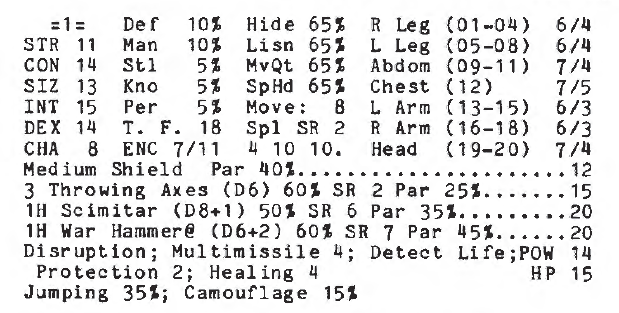
These were collections of randomly-generated NPCs for the unprepared gamemaster. The general aspect of the entries was as follows:


where Def was the RQ2 skill of Defence (which has disappeared in all subsequent editions), T.F. was the Treasure Factor, ENC the Encumbrance (standard/maximum), Spl SR the spell strike rank, and the three labelless numbers the sum of the DEX and SIZ SRs, the attack bonus, and the parry bonus (which could be different at the time). The rest is self-explanatory, with an emphasis on combat statistics: localised hit points and weapon stats.

My Opinion: There’s a lot of information in a very compact stat block. It is excellent for its purpose (a catalogue of randomised NPCs), but I wouldn’t use this format in an adventure.


RQ2 SCENARIOS

Let’s use Snake Pipe Hollow as an example. Here is one of the adventurers the PCs may encounter while exploring the caverns of Chaos.


This is much more readable than the stat bloc from Fangs/Foes, because it’s not as curt, and it seems like it is giving more information. The info provided, however, is pretty much the same. The only extra entries are Languages and Magic Items, and there is a ‘Treasure’ line instead of a Treasure Factor.

My Opinion: As a stat block, it uses up a lot of real estate on the page. I don’t think it’s better than the curt Fangs/Foes format. For a gamemaster in a hurry, however, I must recognise that it is important that the stat block be readable, and in this aspect it’s better than the Fangs/Foes template.


RQ3 SUPPLEMENTS

RuneQuest 3 started a policy of making a difference between important NPCs, who sometimes get several pages of description, and unimportant NPCs, who get a treatment similar to what was the norm in RQ2, e.g., to use an example from the RQ3 edition of Snake Pipe Hollow:


This is similar to the RQ2 treatment, except that the hit location chart has its own space between the characteristics and the weapons block.

My Opinion: Differentiating between important and unimportant NPCs is good. For the latter, however, I still think too much real estate is being used.


RUNEQUEST: ROLEPLAYING IN GLORANTHA

After a long hiatus, RuneQuest returns to us in 2018 in its fourth Chaosium edition. With the addition of Runes and Passions, the basic NPC template has had to accommodate these new entries, of course. Depending on the supplement, the basic NPC template alternates/hesitates between these two formats:

from RuneQuest: Gamemaster Adventures (CHA4029)

from Lands of RuneQuest: Dragon Pass (CHA4037)

These formats provide pretty much the same information as in the older editions, with the addition of Runes, Passions and Ransom.

My Opinion: I think the bottom example is quite good: all the characteristics are on the same line, and the attributes, being to the right of the hit locations block, do not take up any extra space. The second template tries to optimise the space it uses up on the page, but I still think it could be reduced.

MY RECOMMENDATIONS

OK, it is good to criticise, but it is better to provide solutions, and I can hear you all saying “Awright, smarty pants, how would you do it?”

Well, here are my recommendations.

Major NPCs

For major NPCs, the gamemaster needs to have a maximum of information available under their eye, because the slightest oversight could ruin an encounter. Here is how I typically describe major NPCs:

NPC Name

Male/Female, Species, age XX, from //place, member of //organisation, initiate of //cult

STR XX CON XX SIZ XX DEX XX INT XX POW XX CHA XX

Hit Points: XX Move: 8

DEX SR: X SIZ SR: X

Runes: list all Runes in alphabetical order with their value, e.g. Air XX%, Death XX%, Fire XX%, Stasis XX%, Water XX%.

Rune Points: 3 (Cult)

Rune Spells: All common Rune spells plus Catseye, Command (Hawks), Sunbright.

Magic Points: XX

Spirit Magic: Co-ordination (2), Lightwall (4), Multimissile 2.

(variable spells have their value without parentheses)

Spirit Combat Damage: 1D6+1

Passions: list all Passions in alphabetical order with their value, e.g. Devotion (Yelmalio) XX%, Hate (Trolls) XX%, Honour XX%.

Reputation: XX%

Armour: heavy scale hauberk (5 pts.), plate greaves and vambraces (6 pts.), closed helm (5 pts.).

(name each piece of armour and indicate the corresponding armour points)

Skills: list all Skills in alphabetical order with their value, e.g. Battle XX%, Climb XX%, Cult Lore (Yelmalio) XX%, Dodge XX%, Homeland Lore (Sun Dome County) XX%, Listen XX%, Move Quietly XX%, Scan XX%, Spirit Combat XX%, Track XX%, Worship (Yelmalio) XX%.

Languages: list all language skills in alphabetical order with their value, spoken first, read/written last, e.g. Firespeech XX%, Heortling XX%, New Pelorian XX%, Praxian XX%, Read/Write New Pelorian XX%.

Ransom: XXX L


Location     D20            Armour/HP

Right leg      1-4              6/6

Left leg         5-8              6/6

Abdomen    9-11           5/6

Chest           12               5/7

Right arm    13-15         6/5

Left arm       16-18         6/5

Head            19-20         5/6


Weapon                          %          Damage            SR         PTS

Short spear                    45         1D6+1+1D4      6            10

Dagger                             45         1D4+2+1D4      7            7

Medium shield              35         1D4+1D4          7            12

Composite bow             50         1D8+1                2            7


Minor NPCs

The information needed for minor NPCs corresponds more or less to the two RuneQuest: Roleplaying in Glorantha examples above.

Typical XX

Member of //organisation | initiate of //cult

STR XX CON XX SIZ XX DEX XX INT XX POW XX CHA XX

Hit Points: XX Move: 8

SR X (DEX: X SIZ: X)

Runes: list only the major Runes, in alphabetical order with their value, e.g. Air XX%, Death XX%.

Rune Points: 3

Cults: Orlanth Adventurous, Humakt

(list the most common cults for this kind of NPC)

Rune Spells: All common Rune spells plus Leap 1+, Shield 1+.

Magic Points: XX

Spirit Magic: Bladesharp 2, Heal 2, Protection 2.

Passions: list only the major Passions, in alphabetical order with their value, e.g. Honour XX%, Loyalty (city militia) XX%.

Armour: heavy scale hauberk (5 pts.), plate greaves and vambraces (6 pts.), closed helm (5 pts.).

Skills: list only skills above 50%, e.g. Battle 55%, Climb 90%, Cult Lore (XXX) 75%, Dodge 75%, Homeland Lore (New Pavis) 60%, Listen 70%, Scan 65%, Track 85%.

Languages: Speak Heortling XX%.

Treasure: XX

Ransom: XXX L


Location     D20            Armour/HP

Right leg      1-4              6/6

Left leg         5-8              6/6

Abdomen    9-11           5/6

Chest           12               5/7

Right arm    13-15         6/5

Left arm       16-18         6/5

Head            19-20         5/6


Weapon                          %          Damage            SR         PTS

Short spear                    45         1D6+1+1D4      6            10

Dagger                             45         1D4+2+1D4      7            7

Medium shield              35         1D4+1D4          7            12

Composite bow             50         1D8+1                2            7


Very Minor NPCs/Mooks

Jondoe the NPC

POW 11

Hit Points: 12

Armour: such and such (3 pts.)

Combat: Uses a <weapon> at XX%, at SR 5, does 1D8+1D6 damage

Magic: Has XXX, XXX, XXXX. Will cast XXX to raise his <weapon> to XX% before entering mรชlรฉe.


Comments: I like how I present information for major NPCs and for mooks. Everything needed to run an encounter with a major NPC is there. For mooks, it is just the bare bones. No localised hit points are indicated because, say, if the mook has 12 hit points it is likely that the GM has a screen that breaks this down into how many hit points each location has. Also mooks would often have the same amount of armour protection in each location.

On the other hand,  I am still dissatisfied with my ‘Minor NPC’ stat block... it is still too large. I guess I could reduce the information for hit locations, armour and weapons (weapon hit points, for instance can be found on the GM screen).

Suggestions are welcome!

27 May 2024

We Are All Us

Titled Cults of RuneQuest: The Lunar Way, the cults book for RuneQuest: Roleplaying in Glorantha detailing the Lunar cults is out at last. I am specifically writing “at last” because, whereas we could always use and slightly adapt the cults that were detailed for the earlier editions of the game for the Storm or the Darkness pantheons (and a few others), there was next-to-nothing if you wanted to stat Lunar NPCs, or play a Lunar player character.

This tome gives us at last the cult descriptions for the following deities: the Seven Mothers, the Crimson Bat, Danfive Xaron, Deezola, Etyries, Hon-eel, Hwarin Dalthippa, Irrippi Ontor, Jakaleel the Witch, Nysalor/Gbaji, the Red Emperor, the Red Goddess, Teelo Norri, Yanafal Tarnils, Yara Aranis. Many cult write-ups contain significant nuggets of Lunar lore, e.g., the write-up of the cult of the Red Emperor, or even wider information, e.g., about Illumination within the Nysalor/Gbaji write-up (and yes, there is much more stuff than in Lords of Terror).

The book may be ordered here (if you buy it from Chaosium, you also get the PDF).


22 January 2024

Animal Shape-Shifters in Glorantha

cover of DW #9
With the exception of the Telmori, the lupine shape-shifters that play a central role in the lore of Dragon Pass and Sartar, and which have been extensively described in several RQ and HQ supplements, animal shape-changers have never been precisely described in Gloranthan products. Worse than that, what little information we may find in the sources is often contradictory.

In RuneQuest 2nd edition (their first appearance), for instance, animal shape-shifters are described as follows under the heading Lycanthropes:

“Shape changers are a lonely breed, tainted with Chaos, and disdainful of civilisation. Few know whether they are animals who can take on human shape, or humans capable of assuming the shape of an animal. In either case, they can assume the strength and senses of the animal form at the expense of some intelligence (varying as to species).

...

Lycanthropes are a very rare breed, no matter what sort of animal they become. The genes for lycanthropy are recessive, so that only matings between lycanthropes will breed true. Most children of two lycanthropes are either animal or human without shapechanging ability.

...

Their Chaotic nature gives them their abilities of shape change and invulnerability to impure metals. They do not receive any of the Chaotic Features shown in Chapter X.

...

The lycanthropes include Bearwalkers, Tiger Sons, Tusk Brothers, and Wolfbrothers.”

In HeroQuest Glorantha, animal shape-shifters are described as follows under the heading Skin-walkers — accompanied by the Beast and Spirit Runes:

“Skin-walkers are shape-changers, and disdainful of civilisation. Few know whether they are animals who can take on human shape, or humans capable of assuming the shape of an animal. In either case, they can assume the strength and senses of the animal form at the expense of some intelligence (varying as to species), with its natural weapons.

...

The skin-walkers known in Dragon Pass and the Holy Country include Bearwalkers, Tiger Sons, Tusk Brothers, and Wolf Brothers. Only the Wolf Brothers are described in further detail here. The God Learners classified them as a type of primitive men they called Hsunchen or Hykimi. There are dozens of different types of Hsunchen throughout the rest of Glorantha.”


In a nutshell, RQ2 tells us that animal shape-changers are lycanthropes tainted by Chaos, whereas HQG describes them as a sort of peculiar Hsunchen. Well, that’s completely different: lycanthropes are basically monsters, whereas Hsunchen are primitive humans. Also, the connection to the Chaos Rune has been replaced by a connection to the Beast and Spirit Runes.


Worse yet, the most recent material (the RQG line) is completely devoid of any references to animal shape-shifters other than the Telmori. The Guide to Glorantha merely mentions (on page 484) that one of the towns in the East Isles has a Tiger Son Guard “comprised of Hsa were-tigers”, which simply adds a layer of confusion since ‘Hsa’ is the name of the tiger Hsunchen tribe according to the Guide (p439 and p561).


It is simply impossible to try and figure out which interpretation is correct (‘monsters’ vs ‘primitive humans’) given the current canon.

A further research on each type of animal shape-changer in the Gloranthan corpus doesn’t provide any particular help either:

A search on ‘Bearwalker’ returns a mention of “the Rathori Bearwalkers from the forests of northern Genertela” in HeroQuest Glorantha, and a very similar one in the Glorantha Sourcebook.
In the HQ supplement Sartar: Kingdom of Heroes, ‘Bearwalkers’ is the name given to the initiates of Odayla (p110). In its sister publication Sartar Companion, there is a description of such an NPC (p133), who “attacks and kills Telmori or Chaos on sight and without hesitation”. We are very far from the Chaotic nature of RQ2 Bearwalkers...
In RQG, ‘Bearwalkers’ is the name given to Odayla Rune Lords (RQG core rules p300, and the Lightbringers p124). 

A search on ‘Tiger Son’ returns a long, unofficial article in Different Worlds issue No.9, and a mention of a Tiger Son initiate of Zorak Zoran in Big Rubble

A search on ‘Tusk Brother’ doesn’t return anything.

So, to summarise:

★ In early Glorantha (end of the 70s, beginning of the 80s), lycanthropes were animal shape-shifters tainted by Chaos. According to the official rules, you had to be born a lycanthrope, whereas Big Rubble and Different Worlds issue No.9 seemed to imply you might become one via a cult.

★ In the early 2010s (at the time of the Guide and of HeroQuest Glorantha), the concept of ‘animal shape-changers’ seems to have become interchangeable with ‘Hsunchen’. The association with the Chaos Rune is gone, except for the Telmori.

★ Today, with the RQG line, there is no all-encompassing concept any longer. You have the Chaotic Telmori; you have the Bearwalkers who are the Rune Lords of Odayla; Tiger Sons and Tusk Brothers have disappeared. As for the Germanic prefix were-, it is used in the Glorantha Bestiary for the Ducks who are “sometimes called durulz or were-ducks” (p31), even though... they are not shape-changers, they are Beast Men! The inconsistency is total.

08 June 2023

Ultra-Fast As-You-Go Character Generation

QuestWorlds features a character generation option called the ‘As-You-Go Method’: instead of fully statting your adventurer at the beginning of the campaign, you simply sketch it to have a general idea and then you fill your ability slots during the course of the game whenever you need to roll under an ability, i.e.:

When events in the story put you in a situation where you want to overcome a story obstacle, or discover the answer to a story question, make up an applicable ability on the spot.


Today’s post is a suggestion to try and use this method for RuneQuest. However, instead of “making up an ability” you will choose among the skills printed on the RQ character sheet.

As with my previous character generation methods, this should work for any character type, except the assistant shaman.


Character Concept

Create a character concept: a homeland, that will give your adventurer their starting languages, and a general profession/background, that will give them reasonable equipment when needed.


Characteristics

Do not roll for characteristics but freely assign the following values: 9, 11, 12, 13, 14, 15, 17 to your characteristics, +4 extra points.

Do not apply the Rune or Homeland modifiers to characteristics (p53 of the core rules) as the values above have already taken them into account.

Compute the skill category modifiers per the rules.


Passions

Reserve three slots for three starting Passions: one at 70% and two at 60%. You will assign them during the course of the game.


Runes

Reserve three slots for three Elemental Runes: one at 60%, one at 40%, and one at 20%. You will assign them during the course of the game.

On top of this, you will be able to add an extra +10% (or +5% twice) to any of these Elemental Runes during the course of the game.


You have a grand total of 50 percentage points that can be added to any Power/Form Runes (max. +25%) during the course of the game.


Skills

Reserve 20 slots for 20 skills that will be improved during the course of the game. You have a grand total of 450 skill points that can be added to these initial skill values during the course of the game. You needn’t use all of the 20 slots – that will depend on whether you want to end up with a specialised adventurer, or one with a broader set of skills. Instead of improving a skill, you may also use a slot to add a new Passion that will start at 60% + the amount of skill points used up.


Skills that fully correspond to the character concept can be raised up to 100%.

Skills that are close to the character concept can be raised up to 75%.

Skills that are unrelated to the character concept can be raised up to 50%.


Cult

Once you have chosen which cult your character will be initiated into, distribute +45 skill points among three to four skills that fit in with the deity’s portfolio or with the deity’s Runes, e.g., Speak Darktongue for an initiate of a Darkness deity.

You also get to choose 5 points of Spirit Magic amongst the cult’s available spells. Your adventurer receives 3 Rune points dedicated to their cult, and an extra Passion at 60% amongst the ones listed under their cult. 

17 November 2021

Ultra-Fast Aldryami Character Generation

The day before yesterday, I wrote that the RuneQuest Starter Set contained all the rules needed to play RuneQuest: Roleplaying in Glorantha except for character generation.

So if you’re not particularly interested in the intricacies of Gloranthan lore, but rather in RuneQuest as a TTRPG engine, you may well purchase the Starter Set and simply use my character generation posts to create your RQ adventurers. You will also need the PDF of the Classic Edition (for weapon stats and for critters), and the Red Book of Magic if you fancy a larger choice of spells.

I have already blogged about the generation of human adventurers. Today we are creating Aldryami player characters in eight easy steps:
1. Passions
2. Rune affinities
3. Characteristics
4. Starting Skills
5. Occupation
6. Cult
7. Personal skill bonuses
8. Misc.

1. Passions

Choose three starting Passions at 60% amongst the ones listed on p17 of Book 1: Rules of the Starter Set. Elves would typically have at least two of the following passions: Hate (Dwarves), Hate (Trolls), Loyalty (Elder Sister), and Loyalty (Great Tree).

2. Rune affinities

2a. Elemental Runes

Male adventurers start with the Fire/Sky Rune at 60%, females with the Earth Rune at 60%. Choose another Elemental Rune (except Darkness) that starts at 40%, and yet another at 20%.

2b. Power Runes

You may choose a Power Rune (it cannot be Death) that starts at 75%.

2c. Form Runes

All Elves start with the Plant Rune at 75% and the Man Rune at 25%, meaning that the Man-Beast axis on p1 of the adventurer folio is replaced with a Man-Plant axis.

3. Characteristics

Do not roll for characteristics but freely assign the following values: 9, 11, 12, 13, 14, 15, 17 to your characteristics, +4 extra points.

INT and DEX cannot be among the four lowest characteristics. STR cannot be among the three highest.

4. Starting Skills

Use the values on p2 of the adventurer folio, with the following changes:

Agility
Climb 70%
Swim 05%

Knowledge
Elf Lore 25%
First Aid 25%
Plant Lore 50%

Magic
Spirit Combat 50%
Worship (...) 30%

Manipulation
Conceal 20%

Perception
Elfsense 40%
Listen 45%
Track 25%

Stealth
Hide 25%
Move Quietly 25%

Attacks - Weapon
Elf Bow 35%
Short Spear 20%
Shortsword 20%
Sing 25%
Small Shield 25%

5. Occupation

Choose an occupational category for your adventurer, and add the relevant skill bonuses:

Artisan
Communication: Bargain +10
Knowledge: Evaluate +5, Lore (...) +10, Plant Lore +30, Speak Other Language (Tradetalk) +10
Manipulation: Conceal +10, 1st Craft +30, 2nd Craft (can be the same) +10
Perception: Elfsense +5, Insight (Elf) +5
Attacks - Weapon: Elf Bow +10

Dignitary
Agility: Dodge +5
Communication: Orate +5
Knowledge: Animal Lore +5, Elf Lore +10, First Aid +5, Homeland Lore (own forest) +5, Plant Lore +25, Speak Other Language (Tradetalk) +5
Perception: Elfsense +15, Listen +5, Scan +5, Search +5
Attacks - Weapon: Elf Bow +20, Short Spear +10, Shortsword +10

Fighter
Agility: Dodge +20
Knowledge: Homeland Lore (own forest) +20
Perception: Elfsense +5
Stealth: Hide +15, Move Quietly +15
Attacks - Weapon: Elf Bow +25, Short Spear +20, Small Shield +15

Sage/Priest
Communication: Dance +5, Sing +15
Knowledge: Alchemy +5, Cult Lore (...) +15, First Aid +15, Lore (...) +5, Plant Lore +25, Treat Disease +15, Treat Poison +5.
Magic: Meditate +5, Spirit Combat +10, Worship (...) +15.

6. Cult

Your adventurer starts off as already being an Initiate of a cult. Elf adventurers are overwhelmingly initiates of Aldrya, which brings the following benefits:

You receive an elf bow, a living plant-weapon that provides you a source of 2D6+2 extra magic points in spellcasting.
The elf bow has the same stats as the composite bow from the pregen folios (except that it has 6 HPs).

You distribute +45 skill points among three or four of the following skills:
Agility: Climb
Communication: Sing
Knowledge: Cult Lore (Aldrya), First Aid, Plant Lore, Read/Write Aldryami
Magic: Meditate, Worship (Aldrya)
Manipulation: Conceal
Perception: Listen, Search, Track
Stealth: Hide, Move Quietly
Attacks - Weapon: Elf Bow, Short Spear

You also get to choose 5 points of Spirit Magic amongst the cult’s available spells: Befuddle, Countermagic, Dispel Magic, Extinguish, Heal, Light, Mobility, Multimissile, Repair, Second Sight, Shimmer, Silence, Speedart, and Vigour. Your adventurer receives 3 Rune points dedicated to their cult and is taught the Rune spell Arrow Trance. You also choose an extra Passion at 60% amongst the following ones: Devotion (Aldrya), Loyalty (Great Tree/Elder Sister).

7. Personal skill bonuses

Finally, add +25 to any four skills, and +10 to five more. No skill may be raised above 100%.

8. Misc

Choose the character’s gender and name.

Determine Age (21±2D8)

Add +1D6+6 to Reputation.

Add +1D20 to a single Passion.

Add +10% to a single Perception or Stealth skill of your choice.

Equipment: leather armour, a small shield, a short spear, a shortsword, and any equipment appropriate to your occupational category.

15 November 2021

RuneQuest Starter Set

The RuneQuest Starter Set is available at last. Chock-full of Gloranthan goodness, it is an absolute must-buy for any serious TTRPG player and/or collector.


chock-full of gaming stuff, for €25 only

I'll point you to someone else's blog post for a ‘standard’ review of the RuneQuest Starter Set. Since this blog is mostly followed by seasoned Gloranthaphiles, I am going to concentrate on what a grizzled Gloranthaphile will find of interest in it and on why you too should purchase it. First and foremost, the RQ Starter Set has been written with years of feedback from newbie and veteran players and GMs, and it shows in how the rules have been clearly laid out, re-organised, and re-written. Honestly, except for character generation (which has been left out of the Starter Set and replaced with 14 pre-generated characters), Book 1: Rules of the Starter Set contains all the rules needed to play RuneQuest: Roleplaying in Glorantha. In this aspect, it is completely different from most TTRPG starter sets that only give you an inkling of the fully-fledged game system, and which require you to purchase the various manuals later on. With the RQ Starter Set, you can skip the purchase of the rulebook if you are happy not to go through the fully-fledged character generation procedure (the one with the adventurer's family history, etc., from the core rulebook) and if you are willing to use a simpler system like, for instance, my accelerated character generation or my ultra-fast character generation.

In some areas, I feel the Starter Set is even superior to the core rulebook. The tricky parry/dodge mechanisms with regards to success quality (fumble, failed, normal, special, critical) are clearly explained, with a very detailed table that details all the various cases with the relavant results. Spirit combat and the shaman–fetch relationship are also expounded upon in a much more unequivocal way than in the core rulebook.

Obviously, Book 2: the World of Glorantha does not attain the encyclopedic depth of the Guide of Glorantha, nor does it give the same overview of the myths and of the religions of Glorantha that the 220-page Sourcebook does, yet it does solve the eternal GM problem of ‘how am I going to quickly introduce Glorantha to my players’. In a mere 21 pages of (dense) text, it manages to give a satisfactory overview of the history of Glorantha, both mundane and mythical, of the Runes and of the Elder Races, of what makes Gloranthan magic and religion different from your vanilla TTRPG setting, and of what organisations your adventurer will gravitate to; it also includes a mini-gazetteer of the Dragon Pass area with the added benefit of it all being for GMs and players alike (which means you can safely pass on the booklet to your players for reading).

This is followed by what can only be described as a mini-campaign setting of Jonstown and northern Sartar. Again, in a mere 39 pages you have everything you need as a GM to run your games in the Jonstown area: city map, gazetteer, guilds, cults, major NPCs, sample NPCs, etc.

Book 3: SoloQuest is a Tunnels and Trolls-like solo adventure that has the double aim of teaching you the rules and of making you familiar with the situation in the Dragon Pass area in 1625. As a seasoned Gloranthaphile, you probably don't need to be taught the rules. However, if you've only played the adventures that were published for RQ2, RQ3 and HeroQuest, you won't be familiar with the new situation (the Dragonrise, the end of the Lunar occupation of Sartar, Argrath's conquest of Prax and Pavis, etc.), and going through the Battle of Dangerford with your player character will brush you up on your Know Glorantha skill.

As implied by its title, Book 4: Adventures presents three adventures set in Jonstown and northern Sartar. The interest for the seasoned GM is, again, to make you familiar with the new political landscape of the Dragon Pass area; the second adventure, A Fire in the Darkness, is particularly useful in this regard. As for the third adventure, the Rainbow Mounds, your players will certainly be extremely surprised if they try and go through it using whatever they may remember from the original RQ2 adventure— the times they are a-changin'!

Last but not least, the Starter Set contains several reference sheets, amongst which a handy ‘Strike Rank Tracker’ with helpful SR-related information directly printed on it such as spell casting times & SRs, held actions, spirit combat, aimed attacks, etc. Again, this should prove useful even for grizzled players & GMs.

07 July 2021

Random Clan Terrain Generator

In 2015 I wrote a blog entry to randomly generate an Imperial Chinese Prefecture for TTRPGs set in Imperial China. I was quite satisfied with my article (itself based on a post on ร‰ric Nieudan's now-defunct web-site), but it has only very recently occurred to me that I could easily adapt it to Sartar to make a Random Clan Terrain Generator!

What you need:
 - A standard 52-card deck with French suits (); remove the jokers and the 2's.
 - Dice.

1. Draw cards to make a 7×7 grid; leave centre of grid empty. The rectangle represents the tula, and the dark grey centre is the main settlement, the clan's capital:


2. Terrain the remaining 48 areas according to card suit; face cards mean there is a steading. See tables below:

 Terrain 
  plains 
  woods or swamp 
 ♥ hills 
 ♠ mountains 

 Steadings 
 Jack: hamlet or stead 
 Queen: temple, shrine, other holy place 
 King: manor or mansion 
 Ace: small town or village 

Choose or draw another card for sub-types, e.g.:

 Second Card Drawn   Settlement Sub-Type   Temple Sub-Type   Manor Sub-Type 
 ♦  Sartarite   Orlanthi  Retired Rune Lord/Priest 
 ♣  Sartarite   Ernaldan  Guildhouse
 ♥  Sartarite   other Sartarite   Local Thane 
 ♠  non-Sartarite (e.g., Sun Domers, Lunar colonists)   pre-Sartarite   Wealthy Landowner 

 Third Card Drawn   other Sartarite Sub-Type   pre-Sartarite Sub-Type 
 ♦  Humakt  True/Dream Dragon 
 ♣  Issaries  Major Spirit
 ♥  Lhankor Mhy  Mysterious otherworldly being
 ♠  other  other

3. Encounters and events. Now, whenever the player characters are travelling throughout the clan territory, random encounters may happen! For each card, roll d20 and compare to card value (Jack = 11, Queen = 12,  King = 13, Ace = 14). If the die roll is = card value, look at the encounter on the table below.

Variant: Use a d10 in the light grey area.

 Die   Civilised Encounters
Die roll < card value 
 Events
Die roll = card value 
 1   Farmers travelling foraging poaching fleeing 
 2   Fishermen working mending nets famished building a dam 
 3   Merchants caravan lost being robbed loaded with silver  Ambush or trap 
 4   Initiates preaching looking for help begging on a pilgrimage   Impromptu market 
 5   Warriors professional rural militia urban militia press-gang   Freak weather 
 6   Orlanthi from Another Clan mercenaries traders transients pilgrims   Blocked roads 
 7   Orlanthi from Another Tribe warband migrating raiding hiding  Fire 
 8   Non-human Tusk Riders Elves Beast Men Trolls  Flood 
 9   Adventurers bruised & beaten hostile friendly richly equipped   Battle 
 10   Lunars tax collectors ♣missionaries colonists soldiers   Ghosts 
 11   Bandits river raiders on the run hiding carrying plunder   Country fair 
 12   Thieves street thugs running from the law spies burglars   Bandit Lair 
 13   Sun Domers merchants ambassadors prisoners pilgrims   Siege 
 14   Plague 

Feedback and suggestions welcome.

08 April 2021

RuneQuest: Roleplaying in Glorantha Ultra-Fast Character Generation

Two years ago, I wrote a blog post titled RuneQuest: Roleplaying in Glorantha Accelerated Character Generation for people who thought the standard RQ chargen process (p23-83 of the core rules) was too time-consuming.

Well, believe it or not, I have received complaints that my system was still too long! After some thought and some testing, I present you the RQ:G Ultra-Fast Character Generation process!

This should work for any character type, except the assistant shaman.

It’s still in eight easy steps but, er, shorter:

1. Homeland choice

2. Character history

3. Rune affinities

4. Characteristics

5. Occupation

6. Cult

7. Personal skill bonuses

8. Misc.


1. Homeland choice

Just write down your choice of homeland, then choose three starting Passions at 60%, irrespective of your homeland. If you’re undecided, or unfamiliar with RQ:G’s passion system, use the following:

  • Love (Family) 60%
  • Loyalty (whatever the referee says will be the core organisation of their campaign) 60%
  • Hate (whatever the referee says will be the main opposition in their campaign) 60%


2. Character history

Let us skip family history altogether (the time-consuming chunk in the core rulebook) and give your character the following:

+1D6 reputation OR 1D6×100 L

+1D20 to a given Passion

+10% to a Communication or Knowledge skill of your choice


3. Rune affinities

3a. Elemental Runes

Roll 3 dice for your primary (60%), secondary (40%), and tertiary (20%) Elemental Runes:

D6 – Elemental Rune

1 – Darkness

2 – Water

3 – Earth

4 – Fire/Sky

5 – Air

6 – Moon

If the result of the second roll is the same as the result of the first roll, re-roll. Ditto for the third roll re: the first and the second rolls.


Finally, add +10% to a single Elemental Rune (even one at 0%).


3b. Power/Form Runes

Roll two dice to determine which of your Power/Form Runes start at 75%:

D10 – Power/Form Rune

1 – Fertility

2 – Death

3 – Harmony

4 – Disorder

5 – Truth

6 – Illusion

7 – Stasis

8 – Movement

9 – Man

10 – Beast

Note: if your first roll was 1, the second cannot be 2, as they are opposing Runes; re-roll the die. Same with 3, 4 – 5, 6 – 7, 8 – 9, 10.


4. Characteristics

Do not roll for characteristics but freely assign the following values: 9, 11, 12, 13, 14, 15, 17 to your characteristics, +4 extra points.

Do not apply the Rune or Homeland modifiers to characteristics (p53 of the core rules) as the values above have already taken them into account.


Attributes & Skill Category Modifiers

Compute them per the rules.


Homeland Cultural Skill Bonuses

Replace the Homeland cultural skill bonuses (p60-63 of the core rules) with the following, depending on your choice of a background for your character:


Urban background

Bargain +5

Dance +5

Intrigue +5

Sing +5

Customs (local) (25)

Farm +25

First Aid +5

Spirit Combat +15

Speak own language (50)

Speak Tradetalk +10

Dagger +5

Battle-Axe +5

1H Spear +15

Sword/Rapier +10

Bow/Sling +10

Javelin +5

Thrown Axe +5

Small shield +5

Medium shield +15

Large shield +15


Generic rural, unmounted

Ride +5

Dance +5

Sing +10

Customs (local) (25)

Farm +20

Herd +5

Survival +5

Spirit combat +15

Speak own language (50)

Speak Tradetalk +10

Dagger +10

Battle-Axe +15

1H Spear +10

Sword +15

Composite bow/Sling +10

Javelin +10

Medium shield +15

Large shield +10


Generic rural, mounted

Ride +35

Customs (local) (25)

Herd +35

Peaceful cut +5

Spirit combat +20

Speak own language (50)

Speak Tradetalk +10

Dagger +10

Lance +15

Sword +10

Composite bow +10

Small shield +15

Medium shield +10


5. Occupation

Replace the Occupational skill bonuses (p63-73 of the core rules) with the following, depending on your choice of an occupational category for your character:


Artisan/Pedlar

Bargain +10

Dance +10

Orate +5

Sing +10

Customs +5

Evaluate +10

First Aid +10

Lore (choose) +15

Manage Household +15

Treat Disease +10

1st Craft +10

2nd Craft (can be the same) +5 

Devise +5

Play (instrument) +10

Insight (humans) +10

Speak Own Language +10

Speak Tradetalk +10

Weapon (mรชlรฉe) +10


Dignitary

Ride +5

Dance +5

Intrigue +10

Orate +20

Sing +15

Customs +5

Lore (choose) +20

Manage household +20

Meditate +5

Worship (deity) +15

Insight (humans) +5

Speak Own Language +5

Read/Write Own Language +10

Weapon (mรชlรฉe) +15

Shield (choose) +15


Irregular Fighter/Lowlife

Climb +5

Disguise +10

Fast Talk +10

First Aid +5

Herd +10

Homeland lore (local) +10

Lore (choose) +10

Peaceful cut +10

Survival +10

Sleight +10

Scan +5

Track +10

Hide +15

Move Quietly +10

First Weapon +30

Second Weapon +5

Shield (choose) +5


Sage/Merchant

Bargain +10

Orate +10

Bureaucracy +10

Customs +15

Evaluate +15

Library Use +10

Lore (choose) +25

Manage household +10

Meditate +5

Insight (humans) +5

Speak Other Language +5

Speak Tradetalk +10

Read/Write Own Language +40

Read/Write Other Language +10


Regular Fighter

Ride +20

Sing +10

Battle +30

First Aid +10

Listen +10

Scan +10

First Weapon +40

Second Weapon +25

Third Weapon +15

Shield (choose) +20


6. Cult

Your adventurer starts off as already being an Initiate of a cult. Choose the cult of your character and apply the skill modifiers on p74-79. Alternatively, and if you want to stay in the spirit of the ‘ultra fast’ character generation rules, simply distribute +45 skill points among three to four skills that fit in with the deity’s portfolio or with the deity’s Runes, e.g., Speak Darktongue for an initiate of a Darkness deity.

You also get to choose 5 points of Spirit Magic amongst the cult’s available spells. Your adventurer receives 3 Rune points dedicated to their cult, and an extra Passion at 60% amongst the ones listed under their cult.

Edit: It is suggested you use the teal-coloured “Initiates of...” boxed texts in the Cults of RuneQuest books as guidelines for the above.


7. Personal skill bonuses

Finally, add +25 to any four skills, and +10 to five more. No skill may be raised above 100%.


8. Misc.

Choose the character’s gender and name. I recommend you use this post to finalise the character’s hair and skin colour.

Determine Age (21±1D4)

Add +5 to Reputation.


18 January 2021

Unusual Weapons for RuneQuest: Roleplaying in Glorantha

As my players might tell you, I love unusual situations in my RQ games, and unusual weapons are an aspect of this. Here are three unusual weapons for your gaming pleasure. Since there aren’t any official statistics for them (yet?), I have created my own, mostly based on old RQ2 publications.

Blowgun

The blowgun is an exotic weapon used in Eastern and Southeastern Genertela. The elf blowgun (also called a dartgun) is described on p22 of the Glorantha Bestiary; the blowgun described below is used by humans, either primitive peoples or assassin cults. Trollkin are also known to use blowguns that are slightly different (they are longer and have 6 HPs).

The blowgun doesn’t do much damage: the reason it is used is because the dart may be poisoned, usually with fast-acting herbal poison (see p159 of RuneQuest: Roleplaying in Glorantha).

Category Name Base % STR DEX Damage HP ENC Range SR
Blowgun Blowgun 10 - 11 1D3 4 (3) 30m 2

Net, Trapping

The net will be described in the upcoming Gods and Goddesses of Glorantha. It is favoured by some Darkness and Chaos cults. Here is a simplified version I have used in my games in the hands of NPCs who wanted to capture the player characters.

A trapping net may be of any SIZ but requires one user per 20 pts. of SIZ. A net must have a larger SIZ than its intended target to entrap them whole; if not, roll the hit location as usual to determine the ensnared location.
The STR of the net is 1.5 times its SIZ.

Category Name Base % STR DEX Damage ENC Range SR
Net Net, Trapping
05 9 9 Special† 2/3* 5m 2/1*

†cannot be parried; can be dodged
*the second figure is for a large net (SIZ>20)

A wholly ensnared character may try to rip open the net by rolling their STR v the STR of the net. It will take two rounds to crawl out of the net.
A net may also be cut through, either by the ensnared character or by their comrades, by delivering an amount of hit points of damage via edged weapons equal to the STR of the net. The problem is that, during combat, any damage to the net by a character outside of it is equally shared by the ensnared character.

A partially ensnared character is ‘wrapped’, see the description of the Whip below.

Whip

The Whip is favoured by Water cults and is quite unusual in the Dragon Pass area. I suggest this weapon should be placed in the hands of transient NPCs, possibly from the Mirrorsea bay area. Ideally the transient NPC should be a herder, teamster, caravaneer, slave merchant, or some ‘evil’ Water cultist (as whips provide Maximum Game Fun in the hands of villains).

The whip is a weapon of fixed range. It is useless beyond its range, and it can only be used to attack a target at equal to or more than half its maximum range. Within that range, the whip is useless.

Category Name Base % STR DEX Damage HP ENC Range SR
Whip Whip 10 9 11 1D4 12 1 5m 1

Wrapping
The whip will wrap around its target on any Special to hit roll. A wrapped victim cannot act. If a leg is caught, the target must roll DEX as a percentage to keep from falling.
The whip will loosen after one round.
If the Special hit is parried with a weapon, or if the hit location was the weapon-wielding arm, the whip encircles the weapon’s shaft and may whip it out of the user’s hand, roll STR v STR to disarm; if the whip user fails to disarm, the target may try a STR v STR roll to pull the whip from the user’s grip.

Whips are unpredictable and have a double fumble range.